How The Primate of The Armenian Church Became Embroiled in a Criminal Case
Following the defeat of Armenia and the unrecognized Nagorno-Karabakh Republic in the 44-day Karabakh War in 2020, Catholicos Garegin II demanded the resignation of Prime Minister Nikol Pashinyan.
By David Petrosyan
Last week, trial judge Hakob Manukyan recused himself from the first hearing of the criminal case involving Catholicos of All Armenians Karekin II and six other senior hierarchs (two archbishops and four bishops) of the Armenian Apostolic Church (hereinafter AAC).
The head of the AAC, Karekin II, was present at the hearing. He and six members of the Supreme Spiritual Council are accused of obstructing the execution of a judicial decision related to the case of former Primate of the Masyatsotn Diocese Gevorg Saroyan.
As a reminder, Armenia was the first country in the world to adopt Christianity as a state religion in 301. The Church considers its founders to be the holy apostles Thaddeus and Bartholomew, who preached in Armenia in the first century. In 451, the Armenian Apostolic Church rejected the decision of the Council of Chalcedon (which established the Christological dogma recognized by the Orthodox and Catholic Churches). Consequently, it separated itself from Byzantine and Roman Orthodoxy, joining the family of Ancient Eastern (pre-Chalcedonian) Orthodox Churches. This family also includes, among the most well-known, the Coptic, Assyrian, and Ethiopian Churches, as well as the Malankara Orthodox Syrian Church of India Among these, the Armenian Apostolic Church is considered the “Elder Sister.”
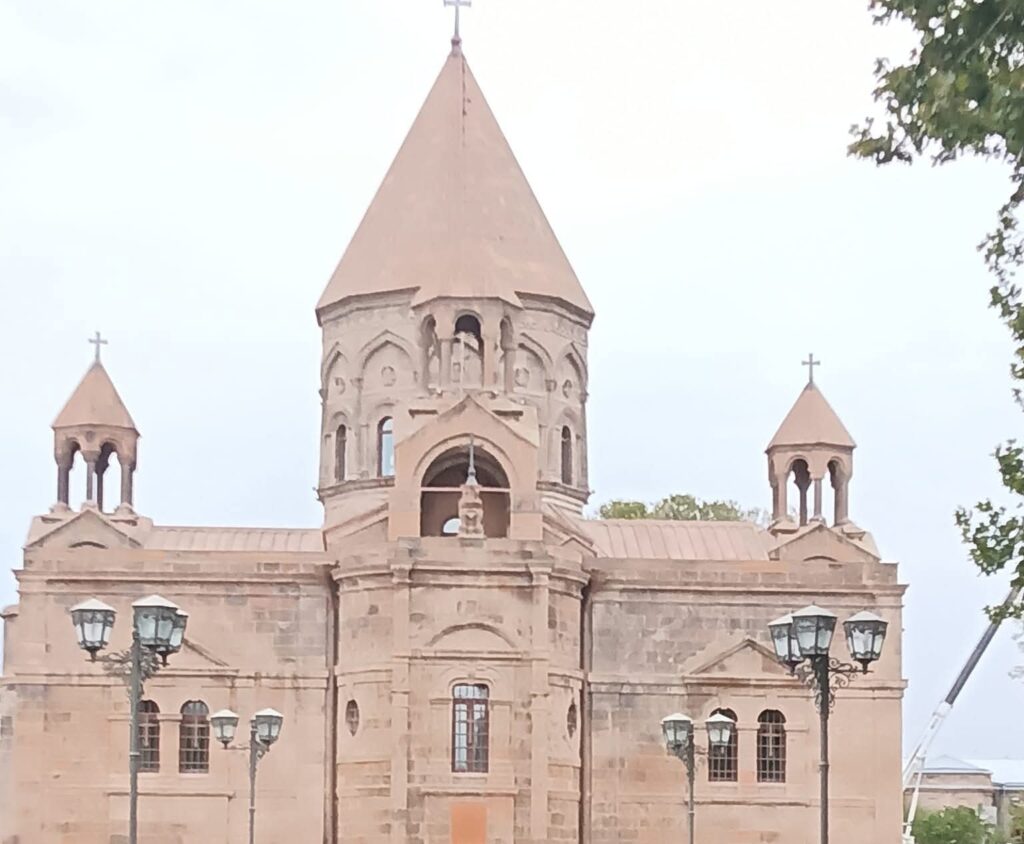
The main center of the Armenian Apostolic Church, headed by the Catholicos and Supreme Patriarch of All Armenians, is located in Holy Etchmiadzin (near Yerevan), where the current cathedral was founded in 303. It is here that the See of the Catholicos is located, who is elected for life by the National Church Council, which is attended by approximately 400 electors (including clergy and laity from all dioceses in various countries around the world). Another center of the Armenian Church is the city of Antelias in Lebanon, home to the Catholicosate of the Great House of Cilicia of the Armenian Apostolic Church. Antelias is the center of the Cilicia Catholicosate, which is administratively and internationally independent, but recognizes the primacy of Etchmiadzin. The Cilicia Catholicosate oversees the dioceses of most Middle Eastern countries.
After a brief excursion into the history of the Armenian Apostolic Church, we now return to the present and attempt to understand how it came about that the Catholicos of All Armenians, for the first time in the church’s more than 1,700-year history, found himself a defendant in a civil court.
Following the defeat of Armenia and the unrecognized Nagorno-Karabakh Republic in the 44-day Karabakh War in 2020, Catholicos Garegin II demanded the resignation of Prime Minister Nikol Pashinyan. However, the resignation of the Prime Minister was demanded not only by the Catholicos, but also by a significant part of society, President Armen Sarkissian, and the General Staff of the Armed Forces.
However, Prime Minister Pashinyan held on to power and won snap parliamentary elections in 2021.
A landslide victory in the elections did not ease domestic political tensions. Thus, in May 2024, the “Sacred Struggle” protest movement emerged in Armenia, led by Archbishop Bagrat Galstanyan, head of the Tavush Diocese of the Armenian Apostolic Church. The protest arose over the delimitation of the border with Azerbaijan and the transfer of territories in the Tavush region to it. Residents of border villages and those who disagreed with government policy took to the streets under the leadership of Archbishop Bagrat. The movement’s participants demanded the resignation of Prime Minister Pashinyan and a change in domestic and foreign policy. The movement held several thousands-strong rallies in Yerevan. Catholicos Garegin II supported Archbishop Bagrat, and former President Robert Kocharyan (1998–2008) attempted to draw a parallel, in our view, with Archbishop Makarios, former President of Cyprus (1960–1977).
In June 2025, Archbishop Bagrat Galstanyan was charged with organizing mass riots, plotting a coup d’état, and terrorism. The movement’s leader denies all charges, calling the criminal case political persecution. Meanwhile, his defense and the archbishop himself are pursuing defamation proceedings, including lawsuits against government officials. However, not only Archbishop Galstanyan but also other hierarchs of the Armenian Apostolic Church (AAC) began to face criminal prosecution, including:
Archbishop Mikael Ajapaghyan, head of the Shirak Diocese (he was charged with publicly calling for the seizure of power and the overthrow of the constitutional order. In September 2025, the court sentenced him to two years in prison);
– In 2025, law enforcement agencies conducted searches and detained five AAC clergy, including Bishop Mkrtich Proshyan (nephew of Karekin II). He was charged with coercion to participate in meetings.
– Archbishop Arshak Khachatryan, head of the chancery of the Mother See of Holy Etchmiadzin, was arrested in December 2025 amid a sharp deterioration in relations between the Armenian authorities and the AAC.
– Samvel Karapetyan, a Russian billionaire of Armenian descent who openly supported the Armenian Apostolic Church and the Catholicos, was held in custody for nearly six months. He is currently under house arrest in Yerevan, and the criminal case against him remains open.
All the aforementioned bishops and archbishops are no longer in custody. However, the charges against them remain.
During 2025 and early 2026, Catholicos Karekin II defrocked a number of hierarchs of the Armenian Apostolic Church and lower-ranking priests. Among those defrocked was Bishop Gevorg Saroyan, head of the Masyatsotn Diocese.
Saroyan filed a lawsuit in the court of first instance against the Armenian Apostolic Church.
In his claim, he demanded that Catholicos Karekin II’s decree dismissing him as head of the diocese be declared invalid and that he be reinstated.
The court upheld the plaintiff’s claim.
The court’s decision is unprecedented. Priests, including high-ranking ones, do not have employment contracts, and the Catholicos has full authority to appoint and dismiss the head of the diocese. Furthermore, in Armenia, according to the Basic Law, Church and State are separate, but the country’s judicial and executive branches appear unaware of this. The judicial decisions handed down by judges in Armenia contradict not only logic, common sense, and domestic legislation, but also the relevant precedents of the European Court of Human Rights (ECHR) and St. Michael’s Parish v. Ukraine (2007). In these decisions, the ECHR determined that civil courts have no right to intervene in internal church disputes.
The Prime Minister stated that he does not recognize Catholicos Karekin II because he violates his celibacy and has begun calling him by his secular name (Ktrich Nersesyan) and demanding his abdication.
In January 2026, Prime Minister Pashinyan and 10 bishops and archbishops of the Armenian Apostolic Church (out of a total of 49) signed a joint statement initiating large-scale church reform and the creation of a coordinating council. The stated goal of this initiative is to remove Catholicos of All Armenians Karekin II and elect a new head of the church. The official church leadership criticized the initiative, calling the created council “self-proclaimed” and declaring such interference unacceptable.
In 2025 and early 2026, Prime Minister Pashinyan participated in services in various churches across Armenia, led either by defrocked priests or by one of these 10 bishops/archbishops. However, this campaign, organized by the prime minister, failed to garner sufficient public support. Apparently, for this reason, it was suspended.
Pashinyan also began accusing several hierarchs of the Armenian Apostolic Church of serving foreign powers. This statement by Pashinyan provoked a campaign in the pro-government press against the Catholicos’s brother, Archbishop Yezras, who heads the Moscow and Nor Nakhichevan dioceses.
From February 17 to 19, 2026, the Episcopal Assembly of the Armenian Apostolic Church, convened at the initiative of Catholicos Karekin II, was held in St. Pölten, Austria. Twenty-five archbishops and bishops from various dioceses, including the Jerusalem and Constantinople Patriarchates, participated in the event. The assembly supported the position of Catholicos Karekin II and his proposed reforms. However, Catholicos Karekin II himself was banned from leaving the country by the Armenian authorities. For the same reason, he was unable to attend the mourning ceremonies for the death of Catholicos-Patriarch of All Georgia Ilia I in March of this year. The ruling Civil Contract party’s election platform for the 2026 parliamentary elections included a special section on reforming the Armenian Apostolic Church, which calls for the removal of the current Catholicos of All Armenians, the election of a locum tenens, the adoption of a new Statute of the Armenian Apostolic Church, and the subsequent election of a new primate. This clause is effectively unconstitutional and implies open interference in the affairs of the Armenian Apostolic Church.
Today, the state is demanding that the Armenian Apostolic Church reinstate the removed diocesan head and former Bishop Saroyan, i.e., comply with the January ruling of the first-instance court.
In this case, we see a demonstration of the undeniable fact that Armenia is a country with a hybrid regime, lacking any independent judiciary and ignoring the very same European legal and regulatory framework. Thus, the statements by Armenian leaders that they are striving for “European standards” of democracy appear to be opportunistic rhetoric and nothing more. The same can be said about the declared ambitions for European Union membership.
As for public opinion in Armenia, it is overwhelmingly on the side of the AAC. Sociological surveys show a consistently high level of public trust in the AAC. According to research (including data from Gallup International), 77.7% of the population rate the AAC’s activities positively. The AAC, as an institution, along with the Armenian Armed Forces, traditionally tops public trust ratings in the country. Trust in the church is several times higher than trust in the executive and legislative branches. The AAC enjoys even greater trust in the diaspora, which is reflected in numerous statements from various organizations in the diaspora.
Judge Hakob Manukyan, who refused to hear the lawsuit against the AAC, understood all this. However, this does not rule out the possibility that the authorities will eventually find the “right judge.” So, if Prime Minister Pashinyan and his team continue to attempt to implement the “reformist” provisions of their election program regarding the Armenian Apostolic Church, they will likely encounter fairly broad socio-political opposition to these initiatives.
David Petrosyan is a Yerevan -based journalist.
Views are personal and IAR neither endorses nor is responsible for the same.
About The Author
