Xi-Putin Meeting in Beijing: Key Takeaways
Putin and Xi have repeatedly pointed out that the China-Russia strategic partnership established by the Treaty of Good-Neighborliness and Friendly Cooperation is a model of neighborly relations.
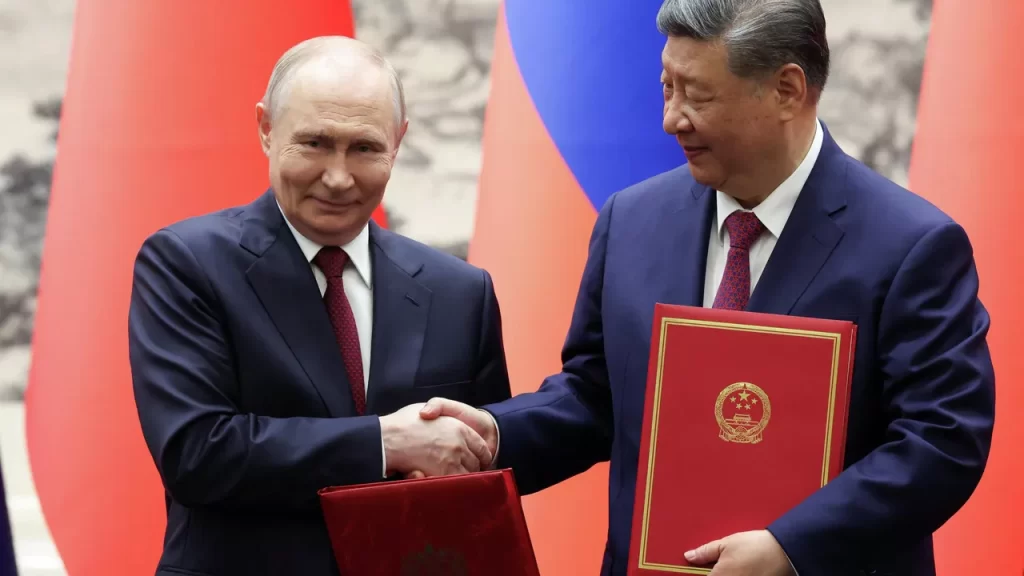
Russian President Vladimir Putin is on an official visit to China from 19 May 2026.
This year marks the 30th anniversary of the establishment of the China-Russia strategic partnership of coordination, the 25th anniversary of the signing of the Treaty of Good-Neighborliness and Friendly Cooperation between China and Russia, and the launch of the “China-Russia Year of Education.”
Leaders of both countries have repeatedly pointed out that the China-Russia strategic partnership established by the Treaty of Good-Neighborliness and Friendly Cooperation is a model of neighborly relations.
High-level meetings between the two countries have been quite frequent. Putin and Xi Jinping began their year-long high-level meetings with a video link on February 4th, at which time the two leaders agreed to hold a face-to-face meeting as soon as possible. Putin’s trip to Beijing will be the first face-to-face meeting between the two heads of state this year, but it will not be the only one.
According to President Putin ‘s side Yuri Ushakov, the Russian president and the Chinese president have agreed to meet during several other multilateral summits: the SCO summit in Bishkek from August 31 to September 1, the BRICS summit in New Delhi from September 12 to 13, and the APEC summit in Shenzhen from November 18 to 19.
The visit assumes greater significance, coming as it did, close on the heels of US President Trump’s visit to China, from May 13th to 15th, Chinese President Xi Jinping received President Trump and his delegation with an exceptionally high level of protocol. Numerous large deals were signed between China and the US, and many cooperative agreements were reached. Some previously mutually restrictive policy restrictions were eased, and the new positioning of Sino-US relations has sparked discussion and global attention.
For Russia, which has a special bond with China, and which has since grown in the aftermath of Russia ‘s Ukraine war and the imposition of economic sanctions by the west, it will be crucial to gauge the mood in Beijing and especially regarding Russia in the aftermath of their meeting.
The joint statement released by both sides affirmed the nature of the partnership – no alliance, no confrontation, and not directed at any third party.
It also expressed concerns over unilateral actions that impede international shipping and threaten the integrity of global supply chains and maritime trade as a whole, while caling out the US-Israeli military attacks against Iran, which they said, had undermined stability in the Middle East. They also pledged support for a sustainable ceasefire in the Gaza Strip.
“Our cooperation in foreign policy is one of the main stabilising factors on the international stage. A complex process of forming a polycentric world based on a balance of interests of all its participants is under way,” Putin said, according to a statement from the Kremlin, reported South China Morning Post.
Forty two agreements were signed by both sides, including intergovernmental and interdepartmental agreements, were signed. A number of agreements and memorandums of understanding were also signed during the talks, including an agreement on cooperation between Russian and Chinese universities.
There has however not been any movement on the “Power of Siberia 2” has pipeline, which is a project that President Putin is keen to implement with Chinese participation.
For China, the policy is diversification of energy basket.
About The Author
