Decoding Marco Rubio’s Armenia Visit
The outcomes of the Rubio visit represent the rapid operationalization of Armenia’s diversified foreign policy, driven by three interconnected pillars of state resilience.
Johnny G. Melikyan
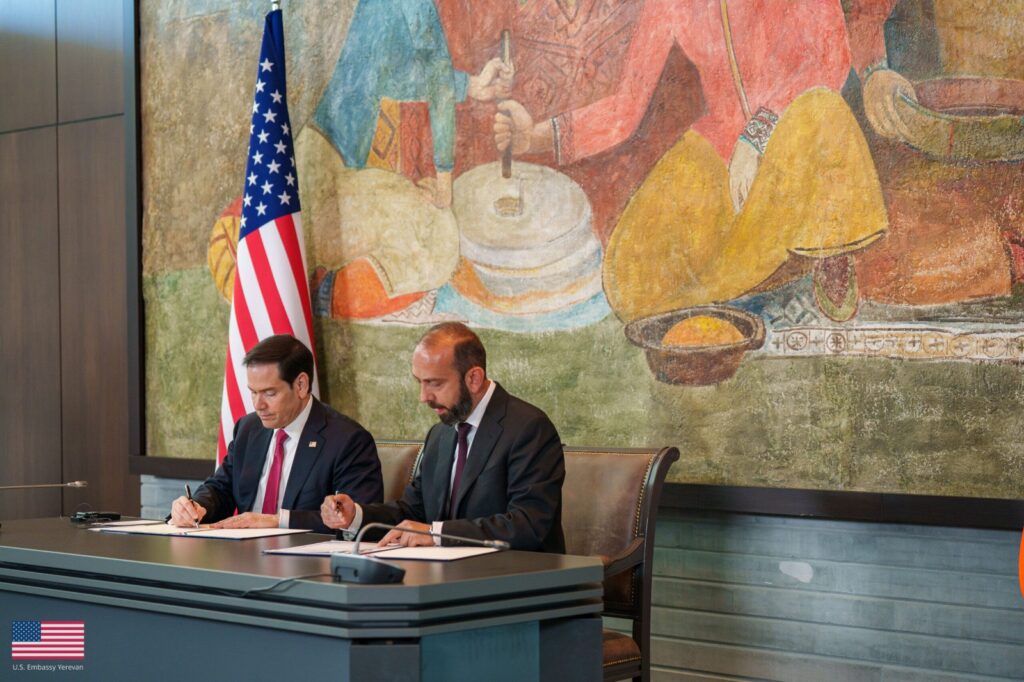
May culminated in a historic milestone for Armenia-US relations with the visit of US Secretary of State Marco Rubio to Yerevan. Meeting with Foreign Minister Ararat Mirzoyan, the summit fundamentally upgraded Yerevan-Washington relations by establishing a landmark Comprehensive Strategic Partnership.
Read Also: Armenia and the United States Elevate Relations to a Comprehensive Strategic Partnership
While the formal remote execution of the central Framework Agreement on the Trump Route for International Peace and Prosperity (TRIPP) was officially finalized later – with Secretary Rubio signing in Washington on June 1 and Minister Mirzoyan in Yerevan on June 4 — the core strategic and legal breakthroughs were firmly anchored during the late-May meetings.
The outcomes of the Rubio visit represent the rapid operationalization of Armenia’s diversified foreign policy, driven by three interconnected pillars of state resilience.
First, the publication of the TRIPP Framework Agreement legally codifies the understanding reached during the 2025 Washington Summit. The text reinforces Armenia’s absolute sovereign jurisdiction and customs control over its territory, utilizing a U.S.-supported “front office-back office” border management model to ensure efficient transit without ceding legal authority.
Read Also: Armenia-Russia Relations: Paving The Way for a Dialogue
Simultaneously, the U.S. International Development Finance Corporation (DFC) approved capital to establish the TRIPP Development Company.
This joint venture will inject critical investments into regional railways, roads, pipelines, and fiber optics, transforming the “Crossroads of Peace” vision into reality.
Second, the signing of the historic Charter on Comprehensive Strategic Partnership fundamentally restructures the bilateral relationship.
This document establishes a predictable framework for regular high-level consultations, defense modernization, and support for democratic governance, serving as the diplomatic umbrella that integrates previous bilateral initiatives into a single, cohesive state strategy.
Third, the Framework for Securing of Supply in the Mining and Processing of Critical Minerals and Rare Earths significantly elevates Armenia’s economic relevance amidst global supply chain re-shoring.
By aligning domestic processing capabilities with Western regulatory standards, the framework deters external economic coercion and integrates Armenia as a vital node in high-tech international manufacturing loops.
Read Also: Armenia: From Crisis to Crisis
Ultimately, the diplomatic workflow observed at the end of May demonstrates an unprecedented speed in bridging political declarations with hard legal commitments.
Following the June 4-th final signing of the TRIPP agreement, the immediate next step involves navigating domestic ratification procedures in Yerevan to ensure swift implementation on the ground.
Johnny G. Melikyan, a Foreign Affairs Specialist, is a Senior Research Fellow at the Yerevan-based Orbeli Centre, a think tank connected to the Office of the Prime Minister of the Republic of Armenia.
Views are personal and IAR neither endorses nor is responsible for the same.
About The Author
