Russia and Two Wars; Ukraine and Iran
Iran entered the scene of the Russo-Ukrainian conflict as an unlikely ally of Russia given the historically difficult relations between the two countries. Iran provided drone technology in the days of Russia’s invasion when the West was convinced that Ukraine had a technological edge over Russia by deploying Turkish Bayraktar drones
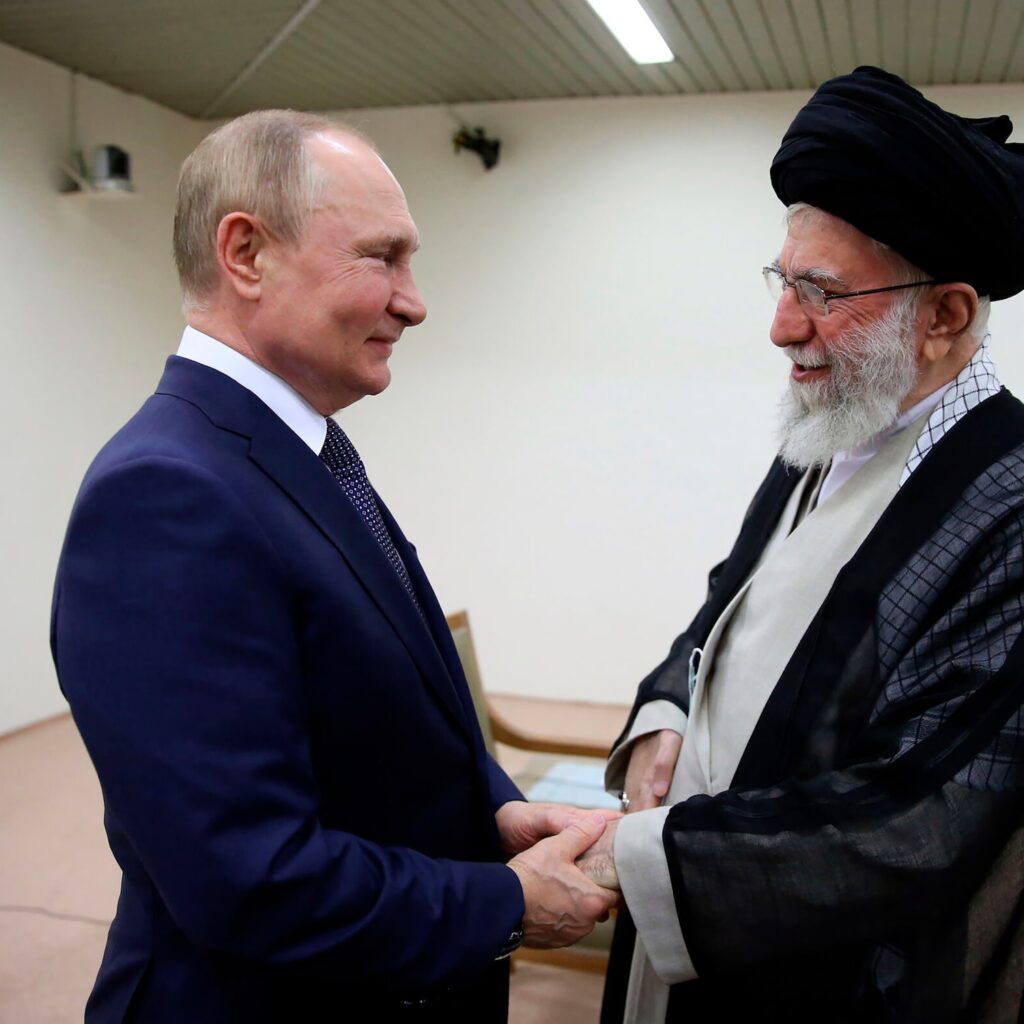
By Krishnan Srinivasan
Two curious media references, one in the western media and the second in India, are notable and worth emphasis. In the west, and almost totally aped word for word by the media elsewhere, is the term ‘full-scale war’ with reference to Russia’s intervention in Ukraine in 2022. To any but the most bigoted observers, Russia has imposed a far from full scale war in Ukraine, considering its underused range, short of nuclear, weaponry and air force. The second reference is the Indian media’s inability to look beyond the biased western sources in their reporting, apparently oblivious or forgetful of Ukraine’s unfavourable if not hostile attitude and actions towards India ever since the break-up of the Soviet Union.
The Ukraine War
As the war in Ukraine enters its fifth year, Russian opinion is convinced that President Vladimir Putin, made no error in initiating it in February 2022 and look back with a sense of achievement, that the war is ending on their terms, perhaps even soon. A feature of this conflict is the discrepancy between Russia’s expectations and how it is interpreted by the Western/Indian media and our so-called expert commentators, who describe Russia’s motives as manifestation of its alleged ambition to establish control over half of Europe whereas Russian intentions are ad hoc and pragmatic — in general terms, they draw a line against NATO’s expansion towards Russia’s borders, which is aimed at Russia’s isolation and containment.
The security-obsessed elements within Russian President Vladimir Putin’s circles have benefitted from the West’s open hostility towards Russia. The interplay between those security elites and hawkish Western lobbies who service the media and military-industrial complex looks like a joint venture that serves both parties with money and influence. In Russia’s case, the conflict in Ukraine – which most Russians see as a proxy war with NATO – allowed these elites to eliminate the pro-Western liberal opposition that once threatened their political position.
In 2019-2021 the then new Ukrainian President Volodymyr Zelenskyy sought rapprochement with Russia – a policy that resulted in a near ceasefire along the front line in the Donbas region where a low-intensity historic conflict had simmered since 2014. Zelenskyy came under pressure from Ukraine’s elites to claim he faced a coup over what was described as capitulation, and hawks in the West persuaded him that Russia could, with their help of course, be defeated militarily, taking a cue from Azerbaijan’s victory over Armenia in the last months of 2020.
Russia’s Special Military Operations
So in January 2021, Zelenskyy made a u-turn in his Russia policy, transformed into a hawk, and clamped down on Putin’s allies to launch a campaign for Ukraine’s NATO membership and against the Nord Stream 2 gas pipeline. This coincided with US President Biden’s inauguration in the White House. In March 2021, Putin started deploying troops at the Ukrainian border, and it took another 11 months before he launched the invasion while Ukraine’s Western friends prepared more to contest Russia than to avert the invasion.
When Putin finally acted, his plan was on the pattern of Russia’s war in Georgia in 2008, prompted by President Saakashvili’s ill-advised western-inspired decision to recapture the breakaway region of South Ossetia. Russia’s ‘invasion’, in reality hardly more a symbolic parade on the assumption that there would be little or no Ukranian resistance, was to force upon Kiev a version of the Minsk agreements, reached in 2014 and 2015 but not implemented due to the bad faith of the participants, OSCE, Ukraine, France and Germany which has since been confirmed by former German chancellor Angela Merkel.
The hope to avoid war along the fortified line of contact in the eastern region of Donbas failed due to the above bad faith, Ukrainian resilience and large-scale Western military aid. The Russians while threatening Kyiv achieved a land corridor between Russia and Crimea that has been annexed in 2014.
After the Istanbul talks of 2022 were derailed – another example of bad faith and folly by Britain and the USA – the Russians chose to regroup, abandoning loosely controlled and difficult-to-hold areas, and settled on a war of attrition along the Donbas front line. They also raised the cost of what they saw as Ukrainian intransigence by formally annexing four partially occupied Ukrainian regions.
The following four years have been a test of both Ukrainian and Russian resilience. Russians see themselves as underdogs in a battle with the Western military-industrial machine, which, in this view, uses Ukrainian proxies as cannon fodder. During the first two years of this war, Western experts and media prophesied the collapse of the Russian army and economy; the former portrayed as an unruly mob of poorly equipped and motivated soldiers and the latter described as a fundamentally brittle.
Neither the Russian economy nor its military machine collapsed. Russia experienced an economic boom during the first two years of the war, when the rouble was the world’s best-performing currency in 2025. The Russian army withstood an Ukrainian counter-offensive of 2023, advertised by Ukraine and the West as an advance for the liberation of Crimea. Russia resumed its slow offensive to break Kyiv’s will rather than occupy huge territories with an ability to adapt and innovate, gradually taking the lead in drone warfare, that makes this war the most technologically advanced form of warfare so far.
Ukraine looks depopulated and deprived of a demographic and economic future, while Russian society continues to enjoy the same lifestyle by and large as before the war. Its human toll of the war, currently estimated at 200,000-219,000 dead by the anti-Putin BBC/Mediazona, is significant for a country of 140 million but primarily affects the most destitute social classes while largely sparing the country’s urban and middle classes. Putin is patiently waiting for Ukrainian and European leaders, heavily invested in satisfactory outcomes of this war, to accept reality on the ground and to find ways of blaming others rather than themselves for the expected outcome.
2026 will see attempts by the Europeans to derail the peace talks under way under US President Trump’s auspices. The delays in a peace settlement come at the cost of Ukrainian lives, territory and devastated infrastructure. The longer the war continues, the more likely it is that Ukrainians will start feeling at least as bitterly about pro-war cheerleaders in the West as about Russia, the prime cause of their suffering.
The Iran War
The US-Israeli attacks on Iran and the assassination of Supreme Leader Ayotallah Ali Khamenei cause concern in Moscow; some Russian commentators warn that Russia could be attacked in the same manner despite its nuclear arsenal although the attack on Iran is vindication of Russian geopolitical strategy and a confirmation of Kremlin’s view of the US-led West as a rogue international actor.
For Putin, the war against Iran echoes 2011 in Libya, when a NATO-led military intervention resulted in the ouster of Libyan leader Muammar Gaddafi. The attack on Libya was ironically facilitated by then Russian President Medvedev’s abstention at a UN Security Council vote. The end of Gaddafi’s regime has brought neither democracy nor prosperity to Libya and plunged the country into civil war and fragmentation. For Putin, it was a glimpse of what awaits Russia should he tolerate the neoliberal democratisation crusade waged by the West. In December that year, protests against fraud in Russian legislative elections by elements in Moscow served to underline these fears. A turning point then arose in Russia’s domestic and foreign policy, with Russia intervening in Ukraine’s Maidan Revolution upheaval less than two years later.
Observing the events in Iran now, Putin probably feels vindicated that his actions in Ukraine were justified, and thankful that his Soviet predecessors that they built the world’s largest nuclear arsenal which ensures Russia’s impregnability. Despite starting a war against his closest European neighbour, Putin considers himself an adherent of the post-World War II order, whose demise in his opinion was precipitated by the US-led West becoming overconfident and reckless.
Ukraine and Georgia became ‘enemy territory’ when NATO decided in 2007 to process their membership. This was followed by the short conflict in Georgia in 2008 which led to the division of that country into Russian majority areas recognized by Russia.
The attacks on Ukraine in 2014 and the invasion of 2022 were regarded by the Kremlin as preventive of the military intervention that Iraq, Libya and Syria experienced and that Iran now faced. Making Ukraine the battlefield of its conflict with the West allows the Kremlin to shield the vast majority of the Russian population from any considerable impact of the war, which is portrayed to the Russian people as inevitable.
Iran and the Ukraine War
Iran entered the scene of the Russo-Ukrainian conflict as an unlikely ally of Russia given the historically difficult relations between the two countries. Iran provided drone technology in the days of Russia’s invasion when the West was convinced that Ukraine had a technological edge over Russia by deploying Turkish Bayraktar drones. Russian-Iranian ties, however, are not robust enough for Moscow to intervene. Additionally, Russia has an informal non-attack understanding with Israel which refuses to supply weapons systems to Ukraine or join anti-Russian sanctions. Israel is also a safe haven for elements of the Russian oligarchy who have historically close links to that country.
Another reason for Russia’s neutrality in the US/Israel war with Iran is President Trump’s near-neutral position on the Russia-Ukraine conflict with attempts to end it through negotiation. Moscow has no wish to allow European leaders to disrupt its relationship with the Trump administration. Even had it wished to help Iran, it had little elbow-room to do so because the Kremlin understands that extending military technology to Iran would jeopardise its relations with Israel and US.
The US-Israeli war against Iran benefits Russia in the short term. It causes a spike in the oil and gas price, which means greater revenue from energy sales by Russia. Higher energy prices also affect the ability of the European Union, Ukraine’s leading funder, to finance the war effort. A prolonged war in the Middle East depletes US arsenals, which could be available to Ukraine, especially when it comes to air defence missiles, and the US involvement in the Middle East means Moscow’s greater leverage in talks with Ukraine.
Finally, Putin stands to benefit from the destruction in Iran, which the US and Israel are trying to sell as something to help Iranians build a freer country. This fortifies the besieged syndrome among Russians and enhances Putin’s aura as a protector of the nation, even if an authoritarian one.
Krishnan Srinivasan is a former foreign secretary.
Views are personal and IAR neitherendorses them, nor is responsible for the same.
About The Author
