What is Happening With the Strait of Hormuz?
By IAR Desk
The Strait of Hormuz is once again at the eye of the storm. Since the outbreak of the US-Israel war on Iran, the Strait has been leveraged by Iran to deny access across the narrow chokepoint to ships and tankers which carry at least 20 per cent of the world ‘s energy supplies.
This has disrupted sylupply chains and caused oil prices to spike above $100 dollars per barrel, creating shocks to global energy markets.
The IEA chief says Strait of Hormuz crisis puts global economy under ‘major threat’; oil prices continue to rise around the world.
What is up with the Strait of Hormuz? Has Iran indeed closed it?
First, let us understand why the Strait of Hormuz is so important.
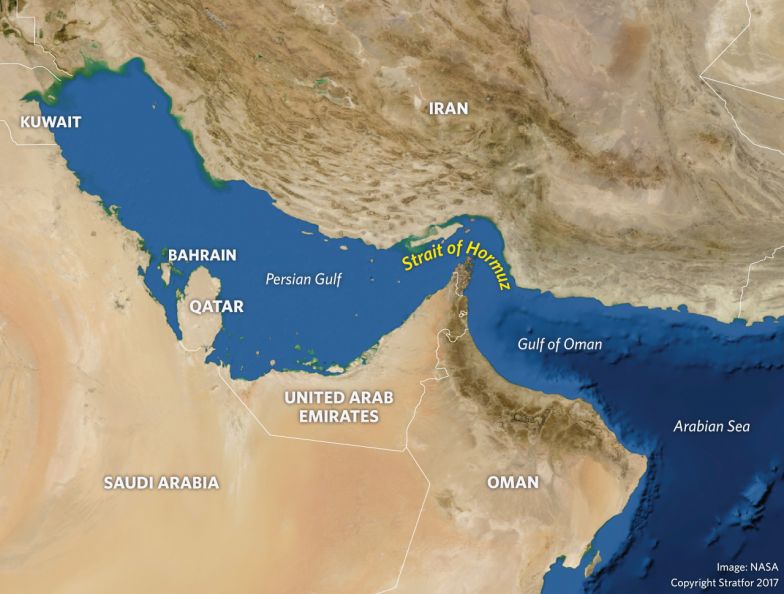
The waterway separates Iran and Oman, linking the Persian Gulf to the Gulf of Oman and Arabian Sea.The Strait is 33 km wide at its narrowest point, and is the world’s most important oil transit chokepoint – narrow channels along widely used global sea routes, and it is critical to the world’s energy security. What makes the Strait so strategic is that almost a fifth of the world’s oil passes through the Strait. In 2025, 34% of all seaborne-traded oil has transited the Strait of Hormuz. The Strait handled approximately 20 million barrels of crude, condensate, and petroleum products daily in 2024–2025.
Iran in the north and Oman in the south have sovereignty over their respective coastal waters which is 12 nautical miles but given the narrow width the waters overlap. This gives Iran considerable leverage over the chokepoint. Under the UN Convention on the Law of the Sea grants transit rights to global shipping.
Most crude exported from Saudi Arabia, Iran, the UAE, Kuwait and Iraq — all members of the Organization of the Petroleum Exporting Countries (OPEC) — is shipped through the waterway. Saudi Arabia moves more crude oil and condensate through the Strait of Hormuz than any other country. In 2024, Saudi exports accounted for 38% of total Hormuz crude flows (5.5 million b/d). Nearly all the liquefied natural gas (LNG) produced by Qatar, the world’s biggest LNG exporter, also traverses through this Strait. Iran: Shipping in Strait of Hormuz continues under new security measures.
Few days into the war Iran announced it would allow only ships of “friendly countries” to pass through the strait. Few ships flagged to Turkiye, Pakistan, and China were allowed to past. Following discussions between Indian Prime Minister Narendra Modi and Iran’s President Massoud Pezeshkian, three India flagged tankers have also been allow to pass.
To keep the strait open to international shipping US President Donald Trump asked for allied like Japan and NATO to firme a force to ensure ships could pass through the strategic waterways. However, no country volunteered.
On 21st March President Trump announced that Iran should fully open up the Strait of Hormuz or he would ‘obliterate’ Iran’s power plants. “If Iran doesn’t FULLY OPEN, WITHOUT THREAT, the Strait of Hormuz, within 48 HOURS from this exact point in time, the US will hit and obliterate their various POWER PLANTS,” Trump wrote on his social media Truth Out.
On 23rd March suddenly Trump announced that he was pausing action for five days, postponing the 2-day deadline for five days, leaving Iran with “one more chance”, saying that the US and Iran had engaged in talks on the “complete and total resolution of hostilities” in the Middle East.
For its part, Iran’s Ministry of Foreign Affairs has declared that maritime traffic through the Strait of Hormuz continues and the vital waterway remains open, though vessels must comply with newly introduced security measures amid the ongoing conflict in the region.
In a statement issued Sunday, the ministry emphasized that the Strait of Hormuz has not been closed, and that shipping has not been halted. It said navigation is continuing while observing necessary precautions and considerations arising from the wartime situation, while reaffirming Iran’s commitment to the principles of freedom of navigation and maritime safety in accordance with international law and the United Nations Charter, noting that these principles must also respect the sovereignty and sovereign rights of coastal states.
The statement said the situation in the Persian Gulf and the Strait of Hormuz has become more dangerous following “military aggression by the United States and the Israeli regime against Iran that began on February 28”, adding that the aggression has directly affected maritime security in the region.
According to the ministry, “Iran has taken measures to prevent the aggressors and their supporters from using the strategic waterway to advance hostile objectives against the country. As the coastal state, Iran said it has barred vessels belonging to or linked with the parties involved in the attacks.”
At the same time, the ministry said ships from other countries can continue to pass safely through the Strait of Hormuz, provided they do not participate in military operations against Iran and comply with the announced safety regulations in coordination with Iranian authorities.
The statement added that responsibility for any instability or disruption in the waterway lies with the United States and the Israeli regime.
India is among the handful of countries whose tankers have been allowed to cross the strait.
The IEA chief says Strait of Hormuz crisis puts global economy under ‘major threat’; oil prices continue to rise around the world.
About The Author
