The Russian Icon and Kalighat Painting as Languages: Natalia Gerasimova
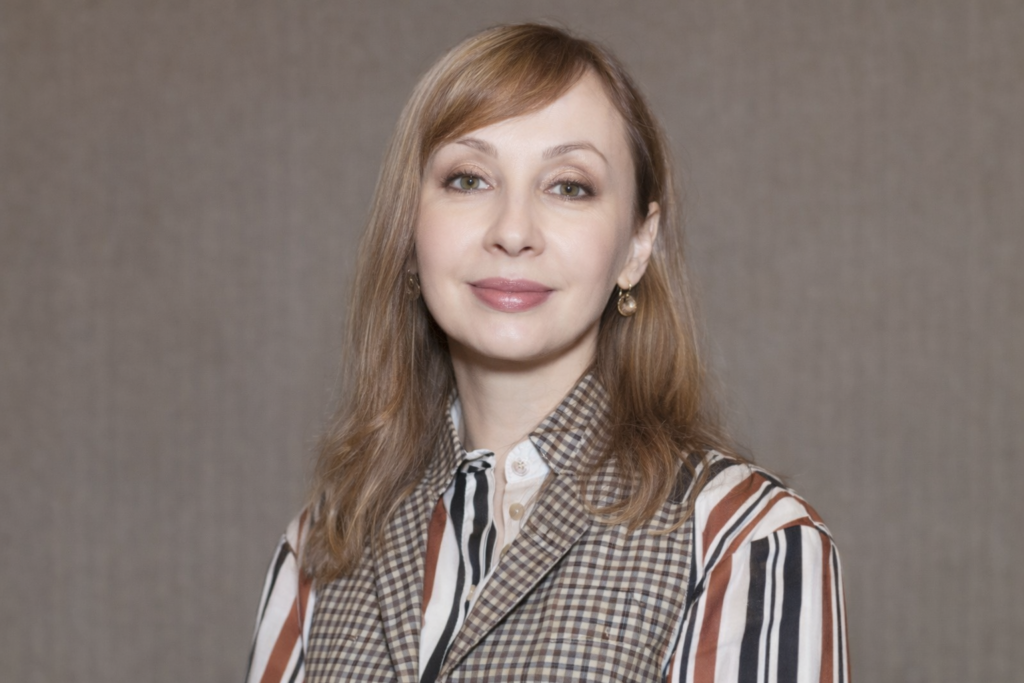
India and Russia share a close and special relationship. Most of the times this relationship is framed in political and defence terms. What often goes unnoticed in public discourse is the deep cultural and emotional bonds the two nations share. One example pointed out by historian Natalia Gerasimova is the artistic expressions of the two cultures. In this tet-a-tet with Aditi Bhaduri she does a comparative analysis of Russian Orthodox icons and eastern India ‘s Kalighat paintings.
Dr. Natalia Gerasimova is a historian, writer, and poet whose work explores the intersections of culture, memory, and identity. She is particularly interested in cross-cultural dialogue, with a focus on the historical and symbolic parallels between Russia and India.
What exactly is an icon? And what is its significance to an average Russian?
An icon is not an image in the ordinary sense; it is a sacred object and a divine presence.
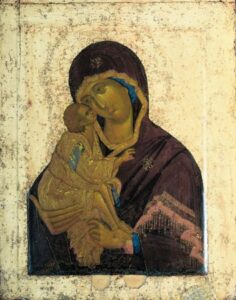
In the Russian Orthodox tradition, the icon is understood as a window into the divine — not into imagination, but into another order of reality. One does not simply look at an icon; one stands before it, enters into relation with it. It mediates between the visible and the invisible, the human and the transcendent.
For an average Russian, even one who is not overtly religious, the icon retains a quiet gravity. It belongs to the intimate space of life — to the home, to memory, to moments of crisis. One turns to it not for explanation, but for orientation, when language begins to fail.
Can you briefly outline Russian Orthodox Christianity? How is it different from Catholicism?
Russian Orthodoxy is rooted in continuity — liturgical, visual, and theological. It places emphasis on mystery rather than definition, on participation rather than interpretation. The divine is approached not through rational clarification, but through presence, ritual, and repetition.
In contrast to Catholicism, which historically developed a more systematic and juridical theology, Orthodoxy resists final formulation. It does not seek to resolve paradox as much as to inhabit it.
This difference is felt not only in doctrine, but in atmosphere: Orthodoxy is less about structure and more about stillness— a sustained attention to what cannot be fully articulated
Please walk us through the history of Russian iconography.
Russian iconography emerges from the Byzantine tradition and takes shape between the 11th and 15th centuries, reaching a remarkable refinement in medieval Rus’, where painting becomes inseparable from prayer.
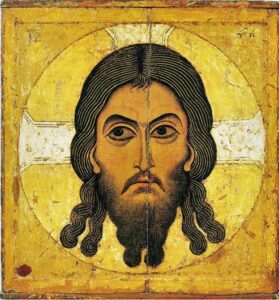
Its highest expression is often associated with Andrei Rublev and Theophanes the Greek, where formal restraint is fused with inner luminosity and spiritual concentration.
From the 17th century onward, under Western influence, the icon gradually shifts toward greater naturalism, losing some of its earlier austerity.
In the early twentieth century, it is rediscovered by the Russian avant-garde — among them Kazimir Malevich and Vladimir Tatlin — who recognise in it not only a religious object, but a radical visual system. Through this rediscovery, the icon re-emerges as a living language.
The Soviet period nearly extinguishes the tradition; yet it survives as latent memory.
What is striking today is that the icon returns not only as an object of faith, but as a visual language still being reactivated.
What is your understanding of Kalighat painting? How did you become acquainted with it?
My interest in Kalighat painting can be traced back to the Rayonists — Natalia Goncharova and Mikhail Larionov — who turned toward the Russian lubok and, in doing so, rediscovered a language of radical simplicity and expressive clarity.
Through this lineage, I became attentive to the striking immediacy of Kalighat.
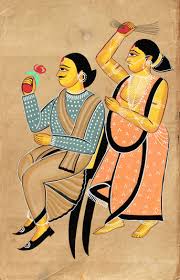
I later encountered it more directly through a COVID-time series by Bhaskar Chitrakar, where the virus appears almost as a character — inserted into familiar scenes and rendered with disarming economy.
Kalighat painting, as I understand it, is both distilled and alive. It reduces the image to a few decisive gestures — a contour, a glance, a posture — yet within that reduction carries wit, satire, and acute social awareness. It does not withdraw from reality; it sharpens it
Do you find any similarities between the Russian icon and Kalighat painting?
Both traditions rely on reduction rather than accumulation. They strip the image to its essential core, trusting that meaning emerges not from detail but from clarity. This shared principle may be described as lapidary expressiveness — a condensed visual language in which each element is precise and necessary.
They share a pronounced frontal orientation: the figure does not recede into illusionistic depth but advances toward the viewer, establishing direct encounter rather than spatial illusion.
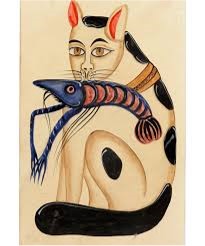
In both, color functions symbolically rather than descriptively. The painted surface does not imitate reality; it generates meaning. Each tone acts as a sign within a system.
Most importantly, both function not simply as styles but as languages — disciplined systems of seeing, grounded in repetition, convention, and internal logic.
What divergences do you see between the two art forms?
The most fundamental divergence lies in their place in human life.
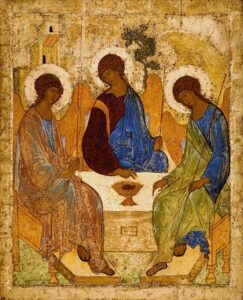
The icon is a sacred, devotional object. It belongs to the sphere of worship and spiritual practice; it mediates between human and divine. Its function is not representational but ontological — it is approached, venerated, and inhabited as a site of encounter.
Kalighat painting, by contrast, belongs to the sphere of everyday and social life. It emerges from the urban environment and engages directly with lived reality — its tensions, humor, and contradictions.
Even within their shared frontal orientation, this difference is palpable.
The icon holds the figure in a state of timeless stillness.
Kalighat introduces movement, gesture, and theatricality.
Where the icon withdraws from the world to reveal another reality, Kalighat enters the world more deeply, often with irony or satire.
Where the icon suspends time, Kalighat captures it.
Where the icon seeks stillness, Kalighat allows for movement.
This is not a contradiction but a productive tension.
One speaks in silence, the other in gesture.
And yet, because both are grounded in the same discipline of reduction — in that shared lapidary clarity — their dialogue remains unexpectedly close, even across this fundamental difference in purpose and presence.
About The Author
