Will Iran Close the Strait of Hormuz?
By Aditi Bhaduri
The Strait of Hormuz,, once again, finds itself in the eye of the storm. The world’s most critical oil shipping chokepoint has been the focus of the international community as tensions escalate between Iran on one hand, and Israel and the US on the other.
Since Israel began the latest round of conflict with its Operation Rising Lion on 13 June, Iran has been threatening to shut down this strategic chokepoint which can deal a severe blow to the world’s economy already reeling under uncertain and unilateral trade and tarrif measures. Closing the Strait is a strategic lever that Iran wields.
After US entered the conflict with its direct strikes on Sunday, 22 June, on Iran’s Ispahan, Natanz, and Fordow, buried deep under a mountain,nuclear sites, carried out using B-2 stealth bombers, Iran’s parliament voted on Sunday to authorieg its potential closure
This has sent shivers down the spines of the international communityas closure would mean immense disruption in trade and energy supplies, triggering fears of an energy crisis.
The Houthis of Yemen – a proxy of Iran – have already significantly disrupted international trade and shipping with their attacks in the Red Sea following the outbreak of Israel-Hamax war on 7th October 2023, which is still continuing.
A closure of the Strait of Hormuz now would trigger an oil shock, inflate crude price, raise freightcosts, reignite inflation, stall ratecut plans and squeeze global household. Economists at Oxford Economics earlier warned that a “worst-case scenario” could see oil prices surge to $130 a barrel, reducing global GDP by 0.8 percentage. Countries have issued advisories to their shipping and trade to reasses movements through the Strait.
The final decision on the closure of the Strait of Hormuz, however, will be made by the the Supreme National Security Council.
While it is quite possible for Iran to take this extreme step, yet the question remains – will it?
Before analysing the likelihood of the Strait of Hormuz, let us see what makes the Straits’ so crucial and significant.
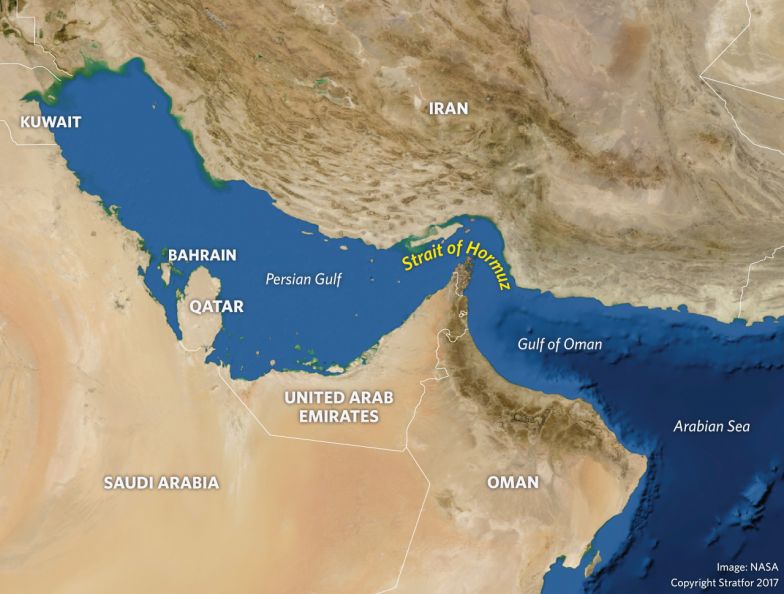
The waterway separates Iran and Oman, linking the Persian Gulf to the Gulf of Oman and Arabian Sea.The Strait is 21 miles (33 km) wide at its narrowest point, but the shipping lane is just two miles (three km) wide in either direction. Almost a fifth of the world’s oil passes through the Strait. So far this year, 34% of all seaborne-traded oil has transited the Strait of Hormuz.
Most crude exported from Saudi Arabia, Iran, the UAE, Kuwait and Iraq — all members of the Organization of the Petroleum Exporting Countries (OPEC) — is shipped through the waterway. The Strait is also the route used for nearly all the liquefied natural gas (LNG) produced by the world’s biggest LNG exporter, Qatar.
So, what are the probabilities that Iran may close or mine these straits’?
Till date during every crisis in the region Iran has threatened to close the Strait of Hormuz.
In January 2012, Iran had threatened to block the Strait in retaliation for the US and European sanctions that targeted its oil revenues in an attempt to stop Tehran’s nuclear programme. In July 2018, then Iranian President Hassan Rouhani hinted Iran could disrupt oil flows through the Strait in response to US calls to reduce Iran’s oil exports to zero. A Revolutionary Guards commander also said Iran would block all exports through the Strait if Iranian exports were stopped. In 2019, In 2019 again, when tensions had flared between Iran and the US over Iran’s IRGC chief Gen. Qasim Soleimani, Iran had threatened to close the critical chokepoint.
Yet at no point has the Islamic Republic effected a total closure of the Strait., even though it did target international shipping through the Strait during these times of crises. Even during the infamous “Tanker Wars” in the 1980s when during its war with Saddam Hussein ‘s Iraq, both Iran and Iraq targeted each other’s shipping , there was no full closure of the Strait.
In terms of exports, both Saudi Arabia and the UAE, two of the major energy exporters have alternatives with pipelines operating to the Red Sea coast and to the port of Fujairah, which lies beyond the Strait of Hormuz. The other exporter Qatar is a friend – 9ne of the few that Iran has in the Arab world- whom Iran would not want to roil.
On the other hand, 76 per cent of the oil passing through the Strait is headed for Asian markets – China, India, South Korea and Japan.
China is one of Iran’s few friends and a strategic partner. When asked about Iran’s parliament reportedly endorsing closing the Strait of Hormuz and whether China has held talks with Iran regarding the issue, Chinese Foreign Ministry spokesperson Guo Jiakun said on Monday that the Persian Gulf and its surrounding waters were vital channels for international goods and energy trade. Safeguarding security and stability in the region serves the common interests of the international community, and that China calls on the international community to intensify efforts to de-escalate tensions and prevent regional instability from having a greater impact on global economic development, the spokesperson said. The message was clear – China would not endorse such a closure by its friend.
India, South Korea, and Japan – are all countries Iran would not wish to strain ties with, especially at this critical juncture. Moreover, India has also assured that it is sourcing oil from other sources – primarily Russia – hence a closure would not impact it hard.
At the same time, Iran’s arch-rival Israel would remain unaffected by such a closure. A closure however would end up hurting Iran’s oil trade as well as those of friendly countries.
The European Union ‘s foreign policy chief Kaja Kallas has also on Monday warned that “Closure of the Strait of Hormuz by Iran is something that would be extremely dangerous and not good for anybody,” Kallas said. Iran may not want to cross swords with the EU, on which, in spite of angry rhetoric, may be banking for the facilitation of future negotiations.
Finally, a closure of the Strait, may or is certain to invite punitive action by the US. The US Fifth Fleet, based in Bahrain, is tasked with protecting the commercial ships in the area. In 2019 when tensions had flared between Iran and the US over Iran’s IRGC chief Gen. Qasim Soleimani, the United States has raised with its allies, including Japan, the possibility of forming a coalition of the willing to protect commercial vessels in the Strait of Hormuz and Bab el-Mandeb. This time around President Donald Trump has proved his willingness and ability for military intervention and escalate the situation if necessary. Iran’s strike on the US military base at Al Udeid in Qatar last night, prove that it does not seek further escalation of the situation. Hence, no matter how tempting it may refrain from a total closure of the Strait of Hormus.
Of course exceptional times call for exceptional methods. And the situation in the Middle East has never been so volatile as it is now. So it is quite possible that in case of any eventuality Iran may still take the unprecedented step of closing the Strait of Hormuz entirely. However, while not impossible, it is quite improbable.
About The Author
