“Our goal is for Russians to see India as a thinking country, beyond yoga and Bollywood”
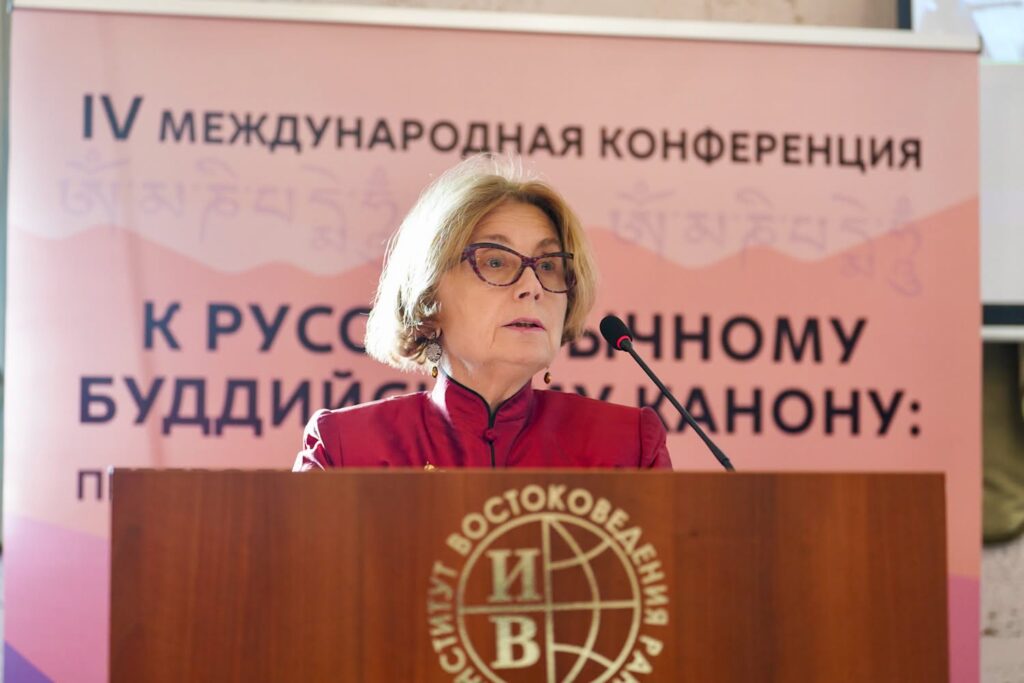
Victoria G. Lyssenko is Head, Eastern Philosophies Sector and a UNESCO Chair, Moscow. Her focus is India, whose culture and philosophy has been the focus of her research and lectures for decades. In this interview with Aditi Bhaduri she outlines the direction of her current work with India:
You are the head of the Eastern Philosophies Sector and a UNESCO Chair. What is your sector currently focused on?
We currently operate under a planned economy and must change our plans every five years. Let me read you our planned topics for recent years:
Specific types and forms of philosophizing based on original texts from Asian traditions (Indian, Chinese, Japanese, Vietnamese, and Arab-Muslim). Comparative analysis of traditional knowledge systems and the specific features of their functioning in a cultural and historical context; Key ideas of Asian philosophical traditions in ontology, epistemology, ethics, and political and religious philosophy in light of contemporary sociocultural and ideological challenges. Methodology of comparative and intercultural approaches to the study of current philosophical issues, taking into account the resources of Asian philosophies. As befits a planned economy, we promise to achieve the following results:
Translation and introduction of new sources from Asian philosophical traditions into scholarly circulation; identification of cognitive paradigms and description of types of rationality, determination of the problematization and categorical apparatus of Asian philosophical systems, analysis of the relationship between methods of philosophizing and the specificity of language.
The results of our research have been published in monographs and a series of articles in leading peer-reviewed journals, and conferences and seminars have been held. These can be found on the Institute of Philosophy website.
How is your work with India progressing?
Relations between Russia and India, despite the political and economic changes in both countries, have always developed in an atmosphere of friendship and deep mutual interest. After the collapse of the USSR, the intensity of official contacts at various levels decreased, while public diplomacy increased sharply. Hundreds of thousands of Russians flocked to India as business tourists, medical tourists, travelers, and seekers of truth.
India has also come to Russia in a variety of forms: individual entrepreneurship (selling jewelry, clothing, and spices), spiritual practices (yoga, meditation, and bhakti), communities of various Indian gurus, and “cultural landing forces” (teachers of dance, music, singing, and languages). Demand among Russians for these Indian brands remains consistently high. It could be said that Russia is developing its own Indian subculture. Many Russians have moved to India, and a distinctive Russian-language subculture has also emerged there.
However, the scientific and educational sphere, which could contribute to the growth of scientific knowledge about India, is, in our opinion, developing unsatisfactorily. During Soviet times, there was a society called “Znaniye,” which was dedicated to disseminating scientific knowledge among various segments of the population. Now, this function is primarily fulfilled by television (primarily the “Kultura” channel), radio, and the internet. Unfortunately, India’s presence in the cultural and educational arena of Russian media is minimal. Television channels are only interested in sensational stories that attract the public (and this primarily concerns yoga and its amazing potential).
Due to the prevalence of a purely Eurocentric approach in Russian education, even among educated sections of society, there is complete ignorance of the real India, its complex history, the diversity of its cultures, and its intellectual achievements, past and present.
Within our sector, a unique Department of Indian Philosophy was established with financial support from the Embassy of India in Russia. The initiative to establish the department belongs to Professor Marietta Tigranovna Stepanyants, Doctor of Sciences, and Chief Research Fellow of the Institute, who founded our sector and headed it until 2012.
Another project supported by the Embassy of India in Russia is my project “Russian Indologists on India.” This series of popular lectures, educational and educational in nature, was intended for students, teachers, academic scholars, and the general educated public interested in India or simply open to the perception of other cultures.
Modern Russian Indology is the inheritor of Soviet and Russian Indology, whose history has seen many dramatic moments. However, despite the difficulties of the post-Soviet period, it remains a highly professional field of academic endeavor. Unfortunately, the influx of young professionals into this challenging profession does not even ensure the simple reproduction necessary for its future survival. Therefore, one of the goals of this educational project is to demonstrate the potential of modern methods and approaches applied to the study of India: textual and hermeneutic analysis, translation and textual interpretation methodology, historical, art, and religious studies of cultural monuments and artifacts of Indian civilization, and anthropological and cultural fieldwork.
We are confident that familiarization with the latest advances in Russian Indology will enrich students’ knowledge of Indian culture and foster a deeper understanding of global processes and our own culture. Our lectures will help university professors, especially those who deliver lectures that typically include extremely brief and inevitably superficial overviews of foreign cultural traditions, better navigate Indian material and distinguish the essential from the unimportant. Finally, those driven by intellectual interest or curiosity about India can find rich food for thought.
Why did you choose lectures by Russian Indologists?
Contemporary Russian Indology has inherited the rich Russian and Soviet tradition. Its history has seen many dramatic moments, and the post-Soviet years were also challenging. And yet, it remains highly professional. The problem lies elsewhere: fewer young people are entering this challenging profession than are needed even to simply maintain it. Therefore, we wanted to demonstrate how fascinating it is to study India using modern methods. This includes textual criticism and hermeneutics, the art of translation and interpretation. This includes historical, art, and religious studies of monuments. This includes the fieldwork of anthropologists.
We believe such lectures provide students with more than just knowledge about India. They help them better understand what’s happening in the world—and in their own culture. For university professors forced to squeeze India into a couple of classes, they help them separate the essential from the unimportant. And for those driven by simple curiosity, they provide abundant food for thought.
What would you like to say to Indian readers?
That India is loved in Russia—and that there are people who love it thoughtfully, with a dictionary in hand. Our goal is for Russians to see India as a thinking country, beyond yoga and Bollywood””; a country of philosophers, grammarians, logicians, and scientists. And I’m confident that such a dialogue will enrich both sides. We’re open to Indian colleagues—come to our conferences and propose joint projects. Dialogue between cultures requires direct contact with the Other.
About The Author
