General Waker’s Moscow Visit: Power, Paradox, and the Peril of Uncertainty in Bangladesh
Whether the Moscow initiative signals a genuine commitment to plural sovereignty or merely a tactical maneuver amid internal volatility will depend on the months ahead. Yet the visit, rich in symbolism and laden with strategic subtext
By Anwar A. Khan
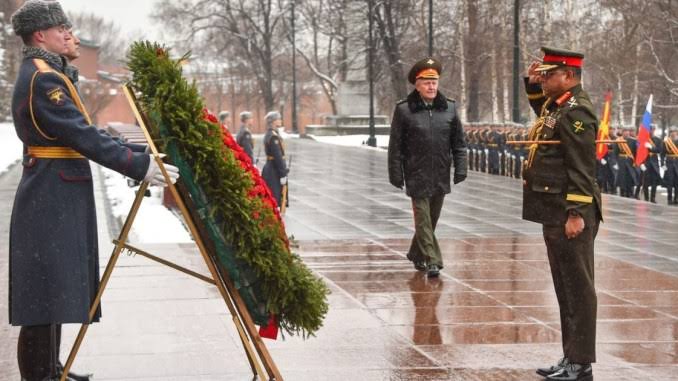
In a world increasingly fragmented by geopolitical realignments and ideological dissonance, the recent Moscow visit by General Waker-Uz-Zaman, Chief of Army Staff of Bangladesh, emerges as a poignant inflection point—more than military diplomacy, it is a calculated gesture of strategic autonomy. Set against the backdrop of domestic turmoil and contested regional narratives, the visit encapsulates a complex recalibration of Bangladesh’s place within the emergent multipolar order.
The context is critical. Following the abrupt and unlawful removal of Prime Minister Sheikh Hasina in August 2024—a rupture that ushered in Nobel laureate Muhammad Yunus as Chief Advisor under controversial circumstances—the Bangladesh’s polity stands at a precipice. Amid institutional erosion and contested legitimacy, the military has increasingly positioned itself as the axis of authority. General Zaman’s foray into Moscow, therefore, cannot be reduced to mere bilateral engagement; it signals the military’s intent to broaden strategic horizons, insulate itself from overdependence on any single patron, and project Bangladesh as an autonomous actor navigating a volatile global terrain though it is highly ambitious.
Strategic Intent: Diversification and Technological Modernization
The core imperatives behind General Zaman’s engagements in Russia can be distilled into two interlocking objectives: military diversification and political signaling. With Bangladesh’s armed forces historically tethered to Chinese defense platforms, there is growing recognition of the vulnerabilities inherent in such asymmetry. Moscow, with its formidable legacy in arms production and an enduring openness to engaging with semi-aligned powers, offers an alternative path—an axis of diversification amid rising Sino-American contestation in the Indo-Pacific.
Though no definitive agreements were publicly announced, discussions reportedly covered key defense areas: advanced air defense systems, electronic warfare capabilities, and bilateral training mechanisms. These may appear incremental, but they embody a broader aspiration to upgrade the operational competence of Bangladesh’s military apparatus, while simultaneously signaling a pivot from single-source dependency to a multi-vector procurement strategy. In effect, the military is seeking both material advantage and geopolitical maneuverability.
Symbolism and Signaling: A Reassertion of Strategic Autonomy
While the defense-related aspects are not negligible, the deeper symbolism of the Moscow visit lies in its geopolitical messaging. At a moment when Western capitals perceive Dhaka as a critical node in Indo-Pacific architecture—especially concerning Myanmar and the Bay of Bengal—General Zaman’s engagement with Moscow functions as a quiet repudiation of what many within Bangladesh correctly see as externally imposed political engineering.
Under the shadow of Yunus’s interim rule, which is widely viewed within the country as lacking democratic legitimacy, the military is asserting its role not only as a stabilizing institution but also as a custodian of strategic sovereignty. By choosing Moscow, Zaman has effectively signaled that Bangladesh will not acquiesce to becoming a passive appendage of Western strategic imperatives. Instead, it intends to revive the spirit of Cold War-era non-alignment, where Dhaka sought equilibrium among contending poles—India, China, the USSR, and the West—without succumbing to any.
This posture revives echoes of the original Bangabandhu doctrine: an instinctual gravitation toward plural alignments and multipolar diplomacy. Yet the current configuration is fraught with paradoxes. Where Sheikh Mujibur Rahman once advanced multilateralism through democratic legitimacy, the present military-dominated landscape lacks such a political foundation. Thus, while the doctrine endures in form, it risks dilution in function.
Geopolitical Reception: Unease, Caution, and Strategic Hedging
The reverberations of Zaman’s visit extend beyond Dhaka and Moscow. In New Delhi, concern is mounting. The resurgence of extremum radical Islamist forces within Bangladesh—once kept in check under Hasina—has triggered anxieties about regional instability. While India may interpret the Moscow outreach as an act of strategic hedging rather than realignment, there is no denying that Dhaka’s current trajectory diverges from prior regional synchrony.
In Beijing, the visit has likely raised concerns over the potential erosion of its privileged defense partnership with Bangladesh. For China, which has made considerable investments in Bangladesh’s infrastructure and military modernization, Russia’s re-entry into the defense equation signals the beginnings of a recalibrated strategic playing field. Meanwhile, Washington views the move as a complicating factor. As it seeks to strengthen its Indo-Pacific alliances, Bangladesh’s overtures to Moscow represent an unwelcome assertion of military independence—an impediment to Washington’s goal of solidifying democratic bulwarks in the region.
Thus, what might appear a bilateral engagement is, in reality, a sophisticated act of multipolar diplomacy—a signal to all and a commitment to none.
Russia-Bangladesh Relations: From Peripheral Engagement to Strategic Utility
Under Sheikh Hasina, Bangladesh’s relations with Russia remained cordial but largely instrumental—defined by sporadic defense purchases and diplomatic courtesies. Under the Yunus-led caretaker administration, however, a more playful dynamic is emerging. General Zaman appears poised to recast the relationship along lines of transactional pragmatism and strategic utility, rather than ideological affinity or nostalgic camaraderie.
This recalibration aligns with Russia’s own pivot toward the Global South, prompted by Western isolation in the aftermath of its war in Ukraine. For Moscow, Dhaka represents not merely a defense client but a potential strategic partner in a region where the West and China increasingly vie for influence. For Bangladesh, Russia offers a counterbalance to unilateral Western conditionalities and a hedge against overexposure to any one bloc.
Still, the sustainability of this emergent alignment remains deeply contingent. It depends on the internal durability of the caretaker regime, the evolving influence of Islamist groups, and the capacity of the military—particularly General Zaman—to maintain institutional coherence amid growing factionalism.
Strategic Fragility and the Illusion of Autonomy
Despite the ambitions implicit in the Moscow visit, a sobering reality persists. Bangladesh’s aspiration for strategic autonomy is undermined by its increasingly precarious internal dynamics. The erosion of democratic norms, the rise of extremist political currents, and the fragility of the transitional regime all conspire to reduce the scope for sovereign decision-making.
General Zaman, though a competent military tactician, lacks substantive political experience. His ability to navigate the fraught interface between domestic legitimacy and international diplomacy remains untested. The peril lies in mistaking symbolic gestures for structural change. Without robust institutions and political pluralism, strategic outreach—however well-intentioned—may dissolve into incoherence or be co-opted by larger powers.
Moreover, the creeping normalization of Islamist actors within the interim regime poses a dual threat: domestically, it risks alienating secular constituencies and eroding social cohesion; internationally, it may provoke recalibrations in how partners like India and the United States perceive and engage with Dhaka.
General Waker-Uz-Zaman’s visit to Moscow may be interpreted as a pivotal moment in Bangladesh’s ongoing search for geopolitical equilibrium. It reflects a desire—perhaps even a desperation—to chart a path beyond the binaries of great-power alignment, domestic authoritarianism, and ideological extremism. Yet this desire exists within a fragile political ecology, one where the boundaries between military stewardship and political overreach are increasingly blurred.
Whether the Moscow initiative signals a genuine commitment to plural sovereignty or merely a tactical maneuver amid internal volatility will depend on the months ahead. The choices made—by generals, by citizens, by politicians and by those who claim to represent the national interest—will determine whether Bangladesh emerges as a strategically balanced state or descends into a contested vassalage.
Yet, the visit, rich in symbolism and laden with strategic subtext, thus opens a ‘new chapter’ in Bangladesh’s evolving narrative—not of triumph or tragedy, but of profound uncertainty shaped by competing visions of sovereignty, security, and survival.
Views are personal and IAR neither endorses nor is responsible for the same.
About The Author
