Armenia, France Elevate Ties to a Strategic Partnership
Armenia & France Sign Strategic Partnership Declaration, Elevating Ties Across Defense, Infrastructure & Technology as Yerevan Signs Major Defense Deals with French Firms
Zartonk Media
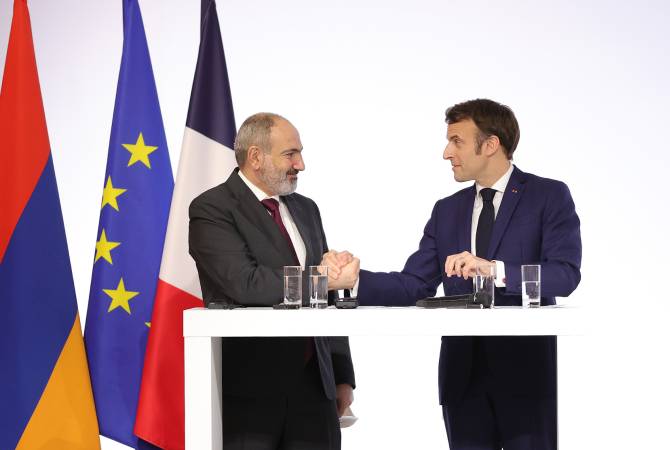
Yerevan: Armenia and France elevated their bilateral ties to a strategic partnership relations by signing a joint declaration on Tuesday, 5 May 2026.
This marks a significant milestone in the development of bilateral ties. The agreement was signed by Armenian Prime Minister Nikol Pashinyan and French President Emmanuel Macron during the French leader’s state visit to Yerevan, underscoring a new level of institutionalized cooperation.
According to the declaration, the two countries agreed to elevate bilateral relations to the level of a strategic partnership based on sovereignty, equality, territorial integrity, democratic values, human rights, and the rule of law. The document states that Armenia and France aim to significantly deepen cooperation across a range of fields, including political, economic, defense, security, technological, educational, cultural, and environmental spheres.
The two sides also reaffirmed their support for lasting peace in the South Caucasus based on respect for sovereignty and territorial integrity, as well as the principles of the UN Charter and the 1991 Alma-Ata Declaration. The declaration underscores Armenia’s commitment to deepening relations with the European Union.
Following the signing ceremony, Pashinyan highlighted that the two countries had achieved substantial progress in various areas even before formally establishing a strategic partnership framework. “If we have achieved this much without having a formal agreement on strategic partnership, I can only imagine what successes and accomplishments await us after establishing it,” Pashinyan said.
Pashinyan also underlined that the strategic partnership document not only reflects the existing level of relations but also creates new opportunities for more effective implementation and expansion of cooperation. “Documents signed at the highest level send a message to different sectors in both countries that favorable political conditions have been created and that all conditions are in place to establish partnerships. It is the role of governments to create a conducive environment so that companies operating in both the private and public sectors can start working together,” the Prime Minister said. He added that the effect of the signing was immediate: “We signed the document and, practically two minutes later, many new opportunities opened up and were realized, and this process will be continuous.”
Macron, for his part, praised Armenia’s transformation over recent years, saying the country had passed through war, then peace, and now prosperity. He noted that Armenia’s economy recorded average annual growth of nearly 6 percent in recent years and said the country had chosen the path of peace, democracy, and closer integration with Europe despite major challenges. “Armenia has always been a full member of the European family,” Macron said, adding that the progress achieved in recent years would have been difficult to imagine only eight years ago. He pointed to the recent European Political Community Summit and the first-ever EU–Armenia Summit held in Yerevan as signs of Armenia’s growing role in Europe’s political landscape.
Defense and Security Cooperation
A major section of the declaration focuses on security and defense cooperation. The two countries agreed to deepen cooperation in defense, military education, and the military-technical and military-technological fields on a long-term basis. They also pledged to continue high-level strategic dialogue between their defense institutions and to expand cooperation in peacekeeping missions, including within the framework of the EU’s Common Security and Defense Policy.
Macron stressed France’s commitment in recent years to supporting the modernization of Armenia’s armed forces and strengthening its sovereignty. “This can be said to be a key pillar of our bilateral relations,” Macron said, referring to cooperation in defense and strategic areas. He added that the strategic partnership agreement opens a new phase of cooperation in defense and security and further reinforces efforts to modernize Armenia’s armed forces.
The declaration also envisages expanded cooperation in cybersecurity, artificial intelligence, countering disinformation, internal security, migration, and disaster risk management. Armenia and France additionally agreed to strengthen joint efforts against terrorism, organized crime, and illegal trafficking.
Economic Cooperation, Infrastructure, and Connectivity
In the economic sphere, the two countries pledged to deepen cooperation in infrastructure, transport, agriculture, healthcare, innovation, renewable energy, semiconductors, aerospace, environmental protection, and financial services. The declaration also supports regional connectivity projects, including Armenia’s “Crossroads of Peace” initiative and the TRIPP project, alongside the EU’s Global Gateway strategy.
Pashinyan placed particular emphasis on a new agreement involving the construction of the Bargushat tunnel as part of Armenia’s North–South highway project, describing the section as one of the most technically challenging parts of the corridor. He said the project represents not only a new phase in the North–South transport corridor but also an opportunity to introduce higher European standards into Armenia’s road construction sector through the involvement of French companies. “This is one of the super-projects being implemented in our country,” Pashinyan said, noting that Armenia’s goal is not only to adopt European standards on paper but also to gain the technical expertise and institutional capacity necessary to implement them.
Macron also pointed to French participation in Armenia’s water infrastructure sector through Veolia, including the Vedi reservoir project and irrigation modernization programs supported by the French Development Agency.
Macron on Russia and the Security Order
Macron used the visit to publicly question the long-standing assumption that Armenia’s security could only be guaranteed by Russia, framing the post-2020 period as evidence that this assumption no longer holds. “For a long time, it was believed that Armenia’s security was possible only under Russian patronage,” Macron said.
“The 2020 war, everything you went through, the tragedy that many Armenian families went through, showed that this was not the patronage that many imagined. We saw that Russia abandoned Armenia.”
Macron added that the conflict and its aftermath had exposed the limits of relying on a single external security guarantor in the South Caucasus, a region he said had long been treated as if it must always be under someone else’s protection. He argued that Armenia had instead demonstrated that another path was possible: “the democratic path that began in 2018, the path of peace and independent development, as well as the path without external domination.” He concluded that the entire region should follow Armenia’s example.
Defending Open Support: Macron Distinguishes Political Backing from Russian Interference
Asked by a French journalist whether his open support for Pashinyan amounted to interference in Armenia’s internal affairs, Macron drew a sharp distinction between openly expressed political positions and covert foreign manipulation. He said it was necessary to distinguish “foreign interventions that try to manipulate democratic life” from “political positions that are openly taken.”
“I undertake this support. I support this colleague of mine, whom I have trusted for eight years, as I did when supporting Moldovan President Maia Sandu, who was facing a non-European alternative. I fully undertake this decision to defend Europe,” Macron said.
He emphasized that such public support is fundamentally different from covert efforts to destabilize democratic institutions, which he attributed directly to Moscow. “This is not the same as influences involving manipulation of information through the media or attempts to undermine the rule of law through the dissemination of false information,” Macron said, adding that such actions are carried out “through foreign agents on the orders of Moscow” with the aim of falsifying democracy. “I voice my arguments, I participate in democracy as the President of France. I do not falsify. That is the difference, and it is important to remember that.”
Pashinyan, responding to the same question regarding Armenia’s rapprochement with the European Union, reiterated his earlier framing. “I answered this question in my speech in the European Parliament in 2023. Armenia is ready to be as close to the EU as the EU deems possible,” he said.
Peace Process and the South Caucasus
Pashinyan highlighted recent progress in the Armenia–Azerbaijan peace process, emphasizing that the Alma-Ata Declaration has been formally accepted as a key principle for border delimitation between the two countries and incorporated into the pre-initialed peace agreement. According to him, the architecture of peace between Armenia and Azerbaijan is now based on mutual recognition of territorial integrity, sovereignty, and the inviolability of borders. Pashinyan said Macron had played a “key role” in helping Armenia and Azerbaijan reach those understandings through diplomatic persistence and flexibility.
France welcomed the first tangible signs of normalization in the region, while emphasizing that further structural steps would be needed.
Concluding his remarks at the press conference, Macron reiterated France’s commitment to supporting Armenia’s efforts to achieve lasting peace in the South Caucasus and welcomed recent progress in trade relations between Armenia and Azerbaijan.
Macron’s “Armenian Moment” at Yerevan Dialogue 2026
Beyond the joint press conference, Macron delivered a separate keynote address at the Yerevan Dialogue 2026 forum, where he framed Armenia’s current trajectory as a historic turning point with implications for the entire South Caucasus. “What we are witnessing now is this Armenian moment,” Macron said, describing it as the culmination of a path Armenia opened through democratic reforms, peace efforts, and economic development. He cited the unprecedented gathering of nearly 50 heads of state at the European Political Community Summit and the inaugural EU-Armenia Summit, both held in Yerevan during the same week.
Macron expressed hope that the Armenian moment could expand into a broader regional transformation. “I would like the ‘Armenia moment’ to also become the moment of the entire Caucasus,” he said. “I have two convictions: first, the South Caucasus should not be an arena for the competition of empires, and second, the region can become a crossroads between Europe, Asia, and the Middle East.” He argued that the key condition for that future was the full reopening of borders, including with Azerbaijan and Turkey, and unrestricted operation of the existing border with Georgia.
Invoking the words of slain Istanbul Armenian journalist Hrant Dink, Macron said it was necessary to destroy the barriers “that turn close peoples into distant neighbors.” He welcomed the first concrete steps in this direction, including Azerbaijan’s removal of trade restrictions with Armenia and the partial reopening of the Armenia-Turkey border for humanitarian purposes, but emphasized that these were only beginnings. “The borders must be fully reopened,” he said.
Macron also reaffirmed France’s continued role in Armenia’s trajectory. “France supports Armenia’s efforts and will stand with it. Armenia is laying the foundations for peace in the entire region,” he said.
Education, Science, and Culture
The declaration outlines plans to strengthen cooperation in education, science, culture, sports, and youth exchanges. The two sides pledged support for the development of the French University in Armenia, the promotion of the French language in Armenia, Armenian language education in France, and expanded cultural and academic partnerships. The document further highlights the importance of decentralized cooperation and civil society partnerships, including regular forums between local authorities and civic organizations from both countries.
Macron praised the role of the French University in Armenia, which currently has around 2,300 students and more than 3,600 graduates, and emphasized the importance of educational, scientific, and cultural cooperation between the two countries.
Climate and Biodiversity
The agreement places strong emphasis on climate action and biodiversity protection, with France expressing support for Armenia’s hosting of the COP17 Biodiversity Conference in Yerevan in 2026.
Additional Agreements Signed
In the presence of the two leaders, thirteen additional agreements were also signed, expanding Armenia–France cooperation beyond defense into high technologies, education, infrastructure, finance, and cultural heritage. These include:
* A Memorandum of Understanding between the Armenian Ministry of High-Tech Industry and the French Ministry of Defense on cooperation in research, development, and innovation in strategic technologies and defense systems
* A Letter of Intent between the governments of Armenia and France on cooperation in artificial intelligence, cybersecurity, and semiconductors
* An agreement between the governments of Armenia and France on the Armenian-French University Foundation in Armenia
* A Memorandum of Understanding between the Armenian Ministry of Territorial Administration and Infrastructure and the French joint venture VINCI Construction Grands Projets and Razel-Bec SAS for the construction of the Bargushat tunnel
* A Memorandum of Understanding between the government of Armenia and the French Development Agency on a new multi-year program for public policy lending in Armenia
* A Memorandum of Understanding between the government of Armenia and the International Alliance for the Protection of Heritage
* A Memorandum of Understanding between the National Mortgage Company refinancing loan organization and the French Development Agency on the development of affordable housing in Armenia
* A loan financing agreement between Armenia’s Ameriabank and the French Proparco company for the promotion of economic cooperation
* A loan financing agreement between Armenia’s Evocabank and the French Proparco company for the promotion of economic cooperation
* An agreement between the Armenian Ministry of Defense and the French Sofema Group for the supply of equipment
* An agreement between the Armenian Ministry of Defense and Airbus Helicopters for the supply of transport helicopters
* A purchase and sale agreement between FlyOne Armenia and Airbus for two A321-200NX aircraft
* A Memorandum of Understanding on cooperation in written and printed heritage between the Matenadaran-Mesrop Mashtots Research Institute of Ancient Manuscripts and the National Library of France, alongside a Memorandum of Understanding on library cooperation between the Yeghishe Charents Museum of Literature and Art and the National Library of France
State Honors Exchanged
On Monday, the two countries also exchanged high-level state honors. By decree of the President of Armenia, French President Emmanuel Macron was awarded the Order of Glory. In return, by decision of Macron, Armenian President Vahagn Khachaturyan and Prime Minister Nikol Pashinyan were awarded the Grand Cross of the Legion of Honour.
About The Author
