Sheikh Hasina’s Death Verdict: A Judgement Steeped in Political Calculus
What unfolded in the International Crimes Tribunal was not a judicial inquiry but a political project—engineered by an unelected regime desperate to legitimise itself by delegitimising the woman who rebuilt the country for three consecutive terms.
By Anwar A. Khan
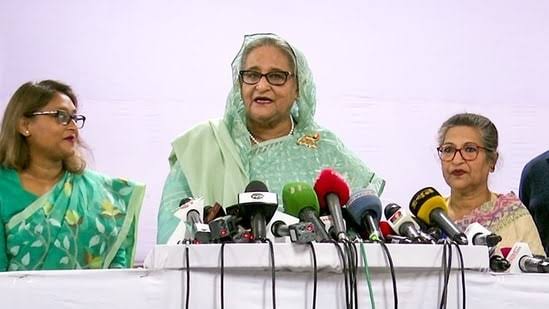
When a nation’s justice system is seized by political vengeance, verdicts become weapons, not judgments. 17th November’s death-sentence handed down to Bangladesh’s most successful Prime Minister, Sheikh Hasina by International Crimes Tribunal (ICT) Bangladesh, stands as a bleak monument to that truth. It is a verdict not rendered by law, but by fear; not born of evidence, but of political orchestration; not a product of justice, but its very negation.
From the beginning, this trial bore all the hallmarks of an outcome predetermined. “The first casualty when war comes is truth,” Senator Hiram Johnson once warned. In Bangladesh today, the war is political, and truth has indeed been executed long before the verdict. What unfolded in the International Crimes Tribunal was not a judicial inquiry but a political project—engineered by an unelected regime desperate to legitimise itself by delegitimising the woman who rebuilt the country for three consecutive terms.
At seventy-eight, Sheikh Hasina stood before the ICT not as a criminal, but as a symbol. She embodied an era of economic growth, empowerment of women, the transformation of rural Bangladesh, a foreign policy rooted in dignity, and a national identity anchored in the Liberation War’s values. To dismantle that symbol, the interim regime required more than a political argument; it needed a spectacle. Today, it got one.
Hasina herself, with characteristic equanimity, dismissed the specter of a death verdict. “I do not care,” she reportedly told party colleagues—an echo of Socrates, who, before drinking the hemlock, reminded Athens that truth outlives verdicts. Her composure in the face of manufactured charges reveals not indifference, but inner certainty: that history—not a compromised tribunal—will deliver the ultimate verdict.
The allegations themselves are riddled with contradictions. Crimes against humanity? Where? When? By what chain of command? Even observers allied with neither political camp have noted the grotesque absence of evidentiary rigor. As Hannah Arendt once wrote, “Where all are guilty, no one is.” Yet in this trial, only one individual was designated guilty—from the beginning.
It is not justice when the accusation is crafted to fit the punishment.
It is not justice when prosecutors echo the talking points of an unelected chief adviser.
It is not justice when judges conduct proceedings under the shadow of intimidation and political coercion by the Jamaati-Shibir mass-murderers of 1971 and 2024.
And it is certainly not justice when nearly all the violence of July–August 2024—independent reports indicate over 90 percent—was inflicted by militant cadres belonged to the Jamaati-Shibir infiltrators opposed to the elected government, while the blame was swiftly, cynically shifted onto Hasina.
This judgment does not merely convict a former Prime Minister. It convicts the credibility of the tribunal itself.
The moral bankruptcy of the present administration is laid bare in its obsession with destroying Sheikh Hasina’s legacy. Even before the trial began, Chief Adviser Muhammad Yunus publicly spoke as though the verdict were already written. Power, he seems to believe, grants the right to rewrite facts, falsify narratives, and silence dissent. But as Václav Havel reminded us, “The power of the powerless lies in the truth.”
If today’s verdict sought to erase Hasina, it has instead immortalised her.
A key tragedy of this moment is what it signals for the nation’s democratic future. Bangladesh’s judicial system—born from the constitutional promise of 1972—was intended to be the guardian of liberty, not the executioner of political rivals. A judiciary that becomes a servant of a political agenda cannot protect the people; it can only persecute them.
For the Awami League, for pro-Liberation forces, for citizens who believe in constitutionalism, this verdict is not an endpoint; it is an alarm bell. It represents the descent of a nation once celebrated for its resilience into the shadows of authoritarian manipulation. A country where verdicts are scripted, judges intimidated, and justice subverted edges dangerously toward institutional collapse.George Orwell once wrote, “In a time of universal deceit, telling the truth becomes a revolutionary act.” In Bangladesh today, even demanding due process has become revolutionary.
But the people of Bangladesh are not without memory, nor without courage. They remember 1971. They remember the assassinations of 1975. They remember the long years of struggle that led back to democracy. And they will remember this day—not for the tribunal’s judgment, but for the injustice it symbolizes.
The international community must recognise the gravity of this moment. A politically motivated death sentence against an elected Prime Minister is not merely a domestic matter—it is a threat to regional stability, democratic norms, and the moral architecture of global human rights.
Yet even in this dark hour, one truth stands immutable: verdicts can be manufactured, but legitimacy cannot. A nation’s conscience cannot be manipulated by courtroom theatrics. Sheikh Hasina may have been condemned by a politically pliant tribunal, but she remains uncondemned in the hearts of millions.
The verdict may stain paper, but it cannot stain history.
In the years ahead, historians will look back on this day and ask not whether Sheikh Hasina was guilty, but how a nation allowed its judicial institutions to be captured by unelected actors, especially, Jamaati-Shibir butchers and the Yunus led illegal puppet government installed by the foreign powers in league with their brutal local collaborators. They will ask how justice was reduced to performance, and how political ambition overshadowed constitutional order.
But they will also record the resilience of a people who refused to surrender their belief in justice, democracy, and national dignity.
Sheikh Hasina once said, “My only crime is that I love my people.” Today, that love has been repaid with a sentence rooted not in evidence, but in fear.
Judicial injustice may seize a momentary triumph for the direful anti-Bangladesh people and their dreaded mango-twigs, but the truth—sheikh like Bangladesh itself—will outlast every lie and endure through every storm
The writer, a Dhaka-based political analyst and commentator, was a freedom fighter in the 1971 war of librration of Bangladesh.
Views are personal and IAR neither endorses nor are responsible for the same.
About The Author
