The Russia–India–China Triangle: Reimagining Power in a Changing World Order
In the shifting chessboard of global politics, the Russia–India–China (RIC) trio stands as both an old idea and a new necessity.
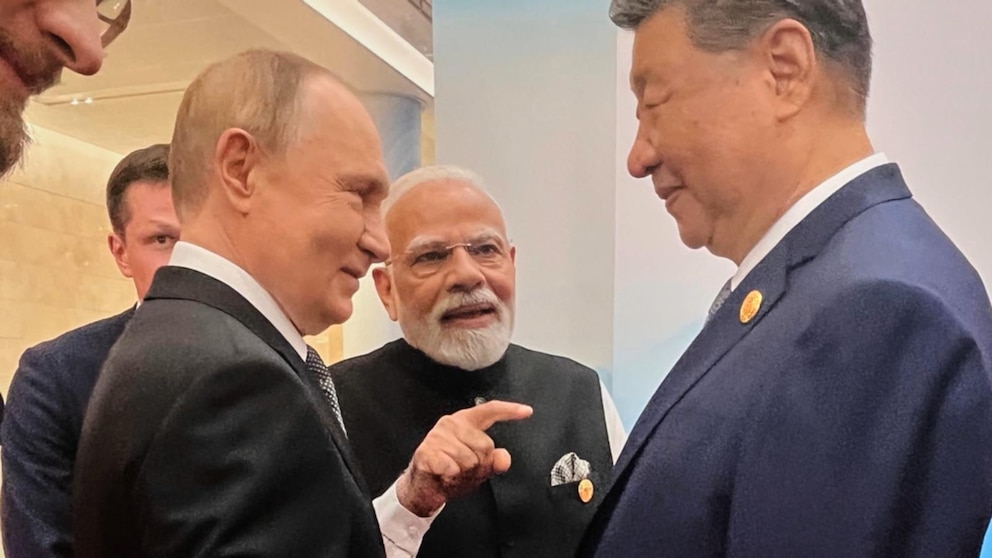
By Anwar A. Khan
In the shifting chessboard of global politics, the Russia–India–China (RIC) trio stands as both an old idea and a new necessity. First imagined in the late 1990s, when Russian foreign minister Yevgeny Primakov proposed a “strategic triangle,” the concept sought to break free of Western dominance and reassert Eurasia as a geopolitical center. More than two decades later, the RIC framework has yet to achieve its full promise. But in a world marked by turbulence, fractured alliances, and the decline of unquestioned Western supremacy, the rationale for closer strategic cooperation between Moscow, New Delhi, and Beijing is stronger than ever.
At stake is more than regional stability. The RIC triangle is a potential fulcrum for reshaping the international system itself—one in which Asia speaks with a stronger voice, multipolarity gains ground, and new forms of regional cooperation are tested against the limits of history, mistrust, and competing ambitions.
A Trio Rooted in Eurasia’s Weight
No three countries loom larger across the Eurasian landmass. Together, Russia, India, and China account for nearly 30 million square kilometers, over 2.5 billion people, vast natural resources, and combined GDP approaching one-fifth of global output. China is the world’s second-largest economy, India has become the fastest-growing major economy, and Russia remains a formidable military and energy power.
Their weight extends beyond economics. Each is a geopolitical heavyweight in its own neighborhood: Russia in Eastern Europe and Central Asia; India in South Asia and the Indian Ocean; China across East Asia and the Pacific Rim.
Collectively, they anchor much of Eurasia’s strategic stability. That fact alone gives the RIC concept enduring significance, even if its institutional machinery lags behind its potential.
The international environment today is far removed from the post-Cold War euphoria that first gave rise to the idea of RIC. U.S. unipolarity has waned, sanctions and new conflicts have pushed Russia closer to the East, India has sought to balance its traditional ties to Moscow with growing cooperation with the United States, and China has emerged as the defining rival to Washington’s global influence.
In this context, the RIC trio offers several strategic advantages:
First, a non-ideological model of cooperation.
Unlike Western alliances bound by shared ideology, the RIC triangle unites three countries with sharply different political systems. Yet all share a preference for independent foreign policies, resistance to Western dominance, and a vision of a multipolar order. Their cooperation demonstrates that alignment need not mean uniformity of values.
Second, it offers economic synergies.
China brings industrial capacity and financial resources, India contributes human capital and technological dynamism, and Russia offers energy, natural resources, and defense technologies. Integrating these strengths could underpin Eurasia’s economic resilience at a time when globalization faces headwinds.
Third, it offers a security architecture for Asia.
From the Korean Peninsula to Afghanistan, from maritime disputes in the South China Sea to terrorism in Central Asia, Asia faces a mosaic of threats. No single power can address these challenges alone. A stronger RIC framework could evolve into a regional platform for security cooperation—less formal than NATO but more cohesive than ad hoc consultations.
The RIC can also be a powerful voice for emerging powers.
In global forums such as BRICS, the G20, or the Shanghai Cooperation Organization, closer RIC alignment enhances the ability of emerging powers to shape debates on trade, climate change, digital governance, and development finance. Speaking in one voice, they could counterbalance Western dominance in setting global norms.
Obstacles That Remain
For all its promise, the RIC concept remains hampered by structural and political barriers.
Enduring Mistrust. Sino-Indian tensions—rooted in border disputes, Tibet, and India’s ties with the United States—remain the most serious fault line. Periodic clashes on the Himalayan frontier remind the world how fragile this leg of the triangle is.
Divergent Strategic Cultures. Russia often views RIC primarily as a geopolitical lever against the West; India tends to hedge between East and West; China envisions RIC as part of a broader Eurasian architecture anchored by its Belt and Road Initiative. These mismatched priorities dilute momentum.
Public Perceptions. Media narratives and public opinion in each country often reflect suspicion, nationalism, and even hostility. Without a deeper culture of trust, trilateral initiatives risk remaining elite-driven and politically fragile.
Competing Neighborhoods. Russia remains protective of its influence in Central Asia; India remains wary of China’s closeness with Pakistan; China must balance its ties to Islamabad with its desire for stable relations with New Delhi. These regional entanglements complicate trilateral unity.
Toward a Stronger RIC
How, then, can Russia, India, and China transform RIC from a promising acronym into a true pillar of regional order? Several steps suggest themselves:
Institutionalize Dialogue. While annual foreign ministerial meetings are useful, they remain insufficient. A permanent secretariat or rotating chairmanship could provide continuity, coordinate initiatives, and ensure follow-up on decisions.
Expand Economic Interdependence.
Trade among the three remains underdeveloped relative to potential. Investments in infrastructure connectivity—linking Russia’s Far East, India’s ports, and China’s Belt and Road corridors—could deepen ties and reduce strategic suspicion.
Focus on Public Diplomacy. Academic exchanges, cultural festivals, and media collaborations could reshape perceptions among younger generations. The future of RIC will depend as much on people-to-people trust as on elite consensus.
Cooperate on Non-Traditional Security.
Joint efforts against terrorism, cyber threats, climate change, and pandemics would showcase RIC’s capacity to deliver tangible public goods. Such cooperation is politically less sensitive and could build momentum for addressing harder security issues.
Draw Lessons from Multilateralism.
Institutions such as ASEAN and the EU demonstrate that even diverse states can build durable frameworks if they prioritize gradual trust-building, incremental integration, and consensus-driven decision-making. RIC should borrow from these experiences rather than attempt grand, sweeping projects from the outset.
The Bigger Picture
Critics may dismiss RIC as a fragile triangle shaped more by rhetoric than reality. Indeed, its progress since 1998 has been uneven and often symbolic. Yet the trio’s importance should not be underestimated. The world is moving toward greater fragmentation: the U.S.–China rivalry deepens, Europe grapples with crises, and global governance struggles to keep pace with transnational challenges. In such a context, Eurasia—home to Russia, India, and China—cannot afford disunity.
The RIC triangle may not become a formal alliance. Nor should it aspire to replicate Western models. Its value lies precisely in offering an alternative: a flexible, pragmatic, and multipolar approach to cooperation that accommodates diversity while pursuing shared strategic interests. If the trio can overcome mistrust and institutional inertia, it has the potential to become not only a stabilizing force in Eurasia but also a laboratory for new forms of international order.
The Russia–India–China triangle is an unfinished project—an aspiration that has yet to match its potential. But the changing international system has made it more relevant than ever. Whether confronting terrorism, shaping trade rules, or designing Asia’s future security architecture, these three powers cannot afford to act in isolation.
If Moscow, New Delhi, and Beijing can strengthen their strategic planning, institutionalize cooperation, and draw lessons from other multilateral experiments, the RIC triangle could rise from a rhetorical construct into a genuine pillar of global governance. In a century where power is diffusing and old hierarchies are fading, the RIC trio may well prove to be one of the keys to building a more balanced and multipolar world.
The author is an independent political analyst based in Dhaka,
About The Author
