Gopalgunge Massacre: Can Bangladesh Ever Heal this Self-afflicted Wound?
The Gopalganj conspiracy, meticulously crafted and ruthlessly executed, brought together the shadowy hands of western intelligence, Pakistan’s ISI, local Islamist radicals from Jamaat-e-Islami and its militant offshoot Shibir, reactionary factions within the Bangladesh Army led by General Waker, and the opportunistic Bangladesh Nationalist Party (BNP).
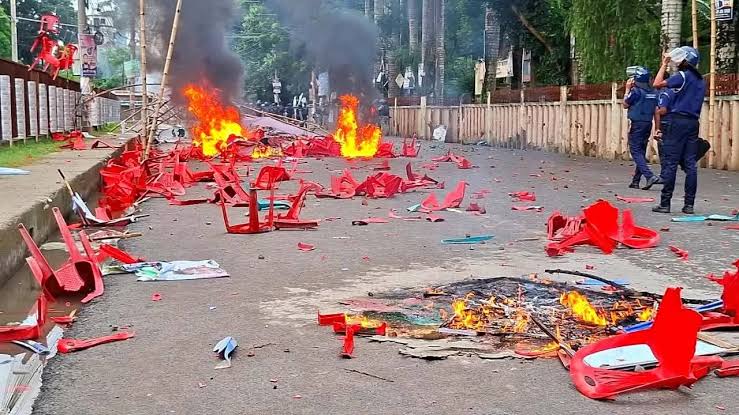
Gopalganj, By Anar A. Khan
On 16 July 2025, Gopalganj—a district steeped in the soul of Bangladesh’s liberation—became the epicenter Gopalgunge Massacreof a national nightmare. It was not merely a brutal attack on a geographic location; it was an affront to the very ethos of the Republic. Gopalganj bled, and with it, the democratic integrity of Bangladesh was gravely wounded.
The events of that dark day must be understood in the broader context of the treacherous political upheaval that began on 5 August 2024. On that day, the elected government of Prime Minister Sheikh Hasina—an architect of modern Bangladesh and the nation’s most transformative leader since independence—was forcibly overthrown. The coup was not an organic expression of domestic discontent but the consequence of a sinister, transnational conspiracy.
This conspiracy, meticulously crafted and ruthlessly executed, brought together the shadowy hands of western intelligence, Pakistan’s ISI, local Islamist radicals from Jamaat-e-Islami and its militant offshoot Shibir, reactionary factions within the Bangladesh Army led by General Waker, and the opportunistic Bangladesh Nationalist Party (BNP).Their common objective: to reverse the course of progress, secularism, and sovereignty that Sheikh Hasina and the Awami League had forged over decades of struggle and sacrifice.
At the center of this neo-imperial plot stands Dr. Muhammad Yunus—a man long promoted by Western institutions as a symbol of economic innovation, but whose ascent to power as “Chief Adviser” on 8 August 2024 marks one of the gravest betrayals in the country’s history. Installed unconstitutionally and without mandate, Yunus has operated not as a leader of the people, but as a proxy for foreign interests—a pawn in a broader attempt to transform Bangladesh into a pliant client state.
This external imposition, cloaked in the language of reform, is in fact an ideological colonization. It seeks to dismantle the nation’s foundational vision—crafted by Bangabandhu Sheikh Mujibur Rahman—and replace it with a hollow narrative built on historical revisionism, the glorification of collaborators, and a complete erasure of the 1971 Bangladesh Liberation War’s moral authority.
The most vicious manifestation of this project emerged on 16 July 2025 in Gopalganj—a district synonymous with national dignity and the very birthplace of Bangabandhu. This sacred land houses the Mausoleum of the Father of the Nation, a site that symbolizes not just personal reverence, but the covenant between a free people and the memory of their struggle for emancipation. Thus, when regime-backed forces, majorly, the Bangladesh Army set out to desecrate this sanctum, it was more than an act of political aggression; it was a sacrilege.
The perpetrators of this atrocity were not fringe elements. They were members of the rebranded Jamaat-e-Islami, now masquerading under the grotesque name of the National Criminal Party (NCP), and emboldened by logistical and military backing from state forces. Under the command of General Waker and with operational support from naval units, a convoy of these ideological vandals advanced toward Tungipara with the intent of violating the final resting place of Bangabandhu—a symbolic assassination of memory itself.
But Gopalganj did not surrender.
With no weapons, no organized leadership, and no protection from state institutions, the people of Gopalganj rose in defiance. They stood unarmed before tanks and troops, forming human barricades with their bodies and resolve. It was a spontaneous act of resistance—pure, unfiltered, and profound. From elderly citizens to schoolchildren, the people formed a living wall against tyranny, echoing the indomitable spirit of 1971.
In response, the regime unleashed a fury characteristic of colonial occupations. On that fateful day, five civilians were summarily executed by army personnel. Thousands were detained, many subjected to torture, humiliation, or made to vanish in the shadows of enforced disappearance. As of today, nearly 75,000 residents of Gopalganj have been imprisoned. More than 500 remain unaccounted for. The surrounding river networks have been locked down by naval blockades, effectively imprisoning an entire district under martial siege.
This campaign of repression is orchestrated by the so-called Home Adviser—an individual with deep ideological ties to Jamaat-e-Islami and a known sympathizer of anti-liberation forces. Under his guidance, a calculated system of psychological terror has been unleashed: midnight raids, curfews, media blackouts, and targeted intimidation now define everyday life in Gopalganj.
Yet, even in the face of such horrors, the people remain unbroken. They have not accepted this illegitimate order. Their courage is a testament to the enduring power of ideals over artillery, of truth over terror.
The broader objective of the Yunus regime is now unmistakably clear. Through the criminalization of the Awami League—the party that led the nation to freedom—the junta seeks to rewrite history. They aim to replace the narrative of liberation with one of capitulation, to elevate traitors as patriots, and to turn Bangladesh into a satellite state under foreign tutelage. They envision a nation where economic mismanagement is passed off as reform, where democracy is reduced to a slogan devoid of substance, and where national pride is bartered for geopolitical obedience.
The silence of the international community in the face of such blatant authoritarianism is not merely disheartening—it is a moral failure. The same Western powers that once extolled the virtues of democracy and human rights now watch in complicit silence as those very principles are trampled in Bangladesh. Their unwavering support for Dr. Yunus, despite mounting evidence of autocratic overreach, makes them accomplices in this descent into despotism.
The events of 16 July 2025 must, therefore, be etched into national memory—not merely as a moment of mourning, but as a turning point in our political destiny. They reveal, with chilling clarity, the anatomy of a modern-day dictatorship imposed under the guise of reform. More importantly, they illuminate the irrepressible will of a people who refuse to be enslaved—people who, time and again, have proven their readiness to die for the idea of a free, just, and sovereign Bangladesh.
To the millions who cherish the dream of Bangabandhu—to those who remember that independence is not a finished chapter but an ongoing commitment—this is a call to action. The martyrs of Gopalganj did not die in vain. Their blood is a sacred charge, a call to reignite the fire of resistance across every district, every village, every home in Bangladesh.
This struggle transcends political parties or electoral cycles. It is a battle for the very soul of the nation. The ideals of 1971—secularism, justice, sovereignty, and dignity—must once again be reclaimed from the ash heap where this illegitimate regime seeks to bury them.
Let the spirit of Gopalganj inspire a grand movement—one not fought with arms, but with conviction, organization, and collective defiance. Let us rise against the tide of authoritarianism and foreign subjugation. Let every Bangladeshi who believes in democracy, justice, and national honor become a sentinel of resistance.
History will not absolve those who remain silent. Future generations will not forgive our failure to act.
The author is a veteran freedom fighter of the 1971 Liberation War and an independent political analyst based in Dhaka.
Views expressed are personal and IAR neither endorses nor is responsible for te same.
About The Author
