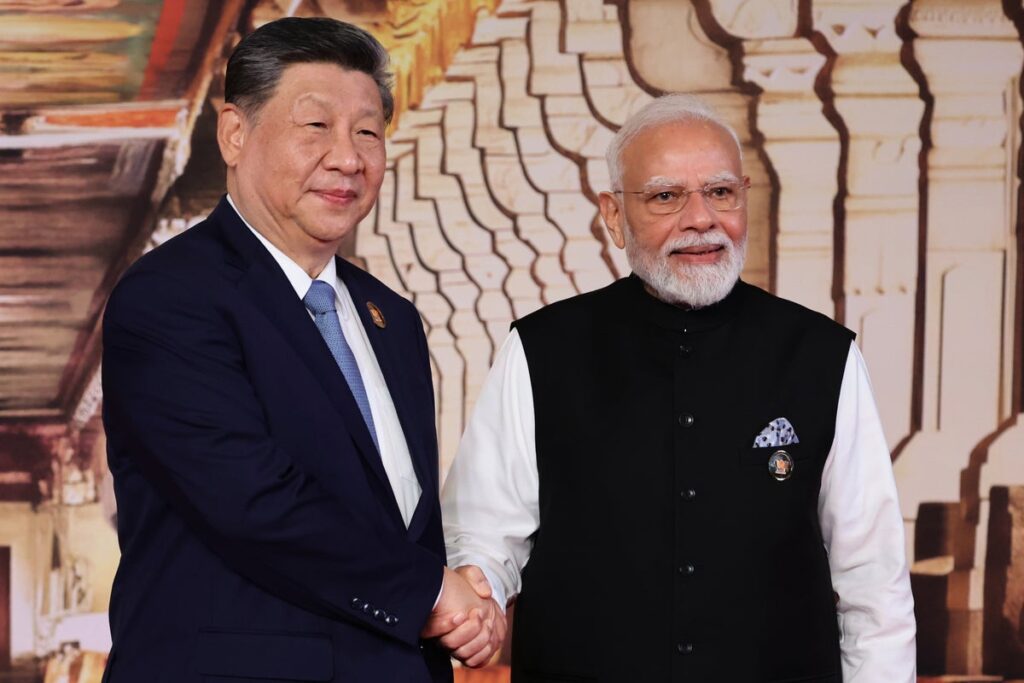
At the heart of this conflict resolution is a civilisational asset — one of tolerance for a completely different system or culture. Chinese president Xi Jinping flagged this point in a video released by the Chinese side as he met Indian prime minister Modi.
“Although our two countries are different in many respects, they are fully capable of complementing each other’s strengths, supporting one another, achieving mutual success and advancing together,” Xi said.
About the Modi-Xi meeting, a handout by the India’s foreign ministry said : “The two leaders expressed commitment to a fair, reasonable and mutually acceptable resolution of the boundary question”.
The festering boundary dispute across the long desolate Himalayan frontier has led to a short war in 1962 and frequent clashes and stand-offs, the latest being the fighting at Ladakh’s Galwan Valley in 2020.
” PM Modi underlined the need for both sides to observe existing agreements and understandings on border related issues,” the Indian external affairs ministry statement said.
It stressed that the two leaders promised to augment cultural, business and transport links between thev two countries.
“On economic and trade relations, they ( Modi and Xi) underlined the need to address each other’s concerns, including structural trade imbalance and supply chain issues, and facilitation of meaningful and predictable market access,”the statement added.
Read Also: “India’s BRICS leadership can offer a forum to stabilize ties with China”
The Xi-Modi bilateral on the sidelines of the BRICS Summit makes it abundantly clear that both India and China have agreed to work together towards resolving the contested border issue.
That is a marked departure from past policy of working round the border dispute by developing trade and other relations even as the dialogue to resolve the border dispute continued at a slow pace. This line emerged from the Deng-Rajiv engagement in the 1980s and was followed up by the 1993 Treaty of Peace and Tranquility. The argument for a peaceful though unresolved border not standing in the way of trade has borne fruit with China emerging as India’s leading trade partner. But the clashes at Doklam ( 2017) and Galwan ( 2020) has reinforced the centrality of the border dispute and its potential to derail the normalisation process.
For India, a permanent border settlement in a boon in terms of reduced military deployment expenditure that will make available more funds for military modernisation. It would facilitate undiluted military focus on fighting a hybrid conflict with terror-backer Pakistan and an increasingly Islamist dispensation in Bangladesh. Chinese investments will not only boost ‘ Make In India’ initiatives byt also help reduce adverse trade balance with China.
Read Also: India-China agree to seek ‘political settlement’ of boundary issue: MEA
For Beijing, a friendly India after border dispute resolution will have very little reason to gravitate towards USA , militarily or otherwise. That is a huge incentive for Xi to reset ties with India, specially in view of a possible fracas with the West over Taiwan. Not unexpectedly therefore, Xi said in Delhi after the bilateral with Modi that Beijing has always viewed and developed China-India relations from a strategic and long-term perspective. This was prominently reported by state-run Xinhua news agency.
The BRICS-time bilateral followed on the 25th round of border resolution dialogue recently held in Beijing , where NSA Ajit Doval strongly pitchrd for an early resolution of the border dispute. This was preceded by foreign minister Wang Yi’s Delhi visit a month back.
If the strategic partnership with US was the defining moment of Modi’s first decade in office , resolving the border dispute with China and befriending it may turn out to the major foreign policy of his current term. This may help the Indian PM spin much electoral dividend and the Chinese PM in his larger plan to isolate the US.
The author is a former BBC and Reuters correspondent, has authored books on South Asian conflicts. He is a former fellow at Oxford , Frankfurt and East-West Center (US) and was closely involved with the Kolkata-Kunming ( K2K) Track2 diplomacy with China.