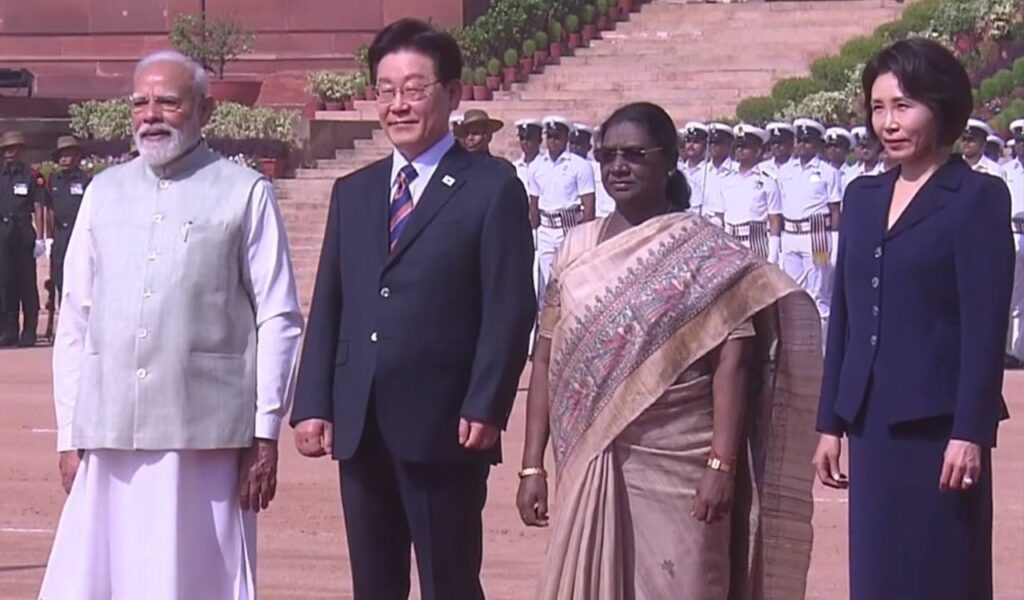
Trade Reset and Agreement Upgrade
Central to the reset is the decision to revamp the Comprehensive Economic Partnership Agreement (CEPA) signed in 2010. Both sides aim to fast-track negotiations to address persistent issues such as trade imbalances and market access barriers.
With bilateral trade currently around $27 billion, the new target represents a major scale-up in economic engagement.
Business and Strategic Sectors
The partnership will expand across key industries, including:
- Semiconductors and advanced manufacturing
- Shipbuilding and steel
- Clean energy and critical minerals
- Artificial intelligence and digital technologies
Leaders emphasised that combining India’s innovation ecosystem with South Korea’s manufacturing strength could unlock new growth opportunities and resilient supply chains. Increased investments and joint ventures are expected to play a central role in this effort.
Diplomacy and Regional Strategy
The renewed push in ties also aligns with India’s Act East Policy, which seeks deeper economic and strategic integration with key Indo-Pacific partners, including South Korea.
A joint statement said that South Korea remains an indispensable partner for New Delhi ‘s Act East Policy, while Seoul views India as a central pillar of its evolving diplomatic outreach, building on the legacy of its New Southern Policy.
The reset comes amid evolving geopolitical dynamics and global supply chain shifts, prompting both nations to strengthen cooperation in critical areas such as energy security, technology, and industrial resilience.
New institutional mechanisms and ministerial-level dialogues are expected to ensure sustained engagement and faster implementation of bilateral initiatives.
If successfully implemented, the roadmap could transform India–South Korea relations into a cornerstone partnership in the Indo-Pacific anchored in trade expansion, technological collaboration, and strategic alignment.