How PM Mark Carney’s India Visit Is Rewiring Middle-Powers’ Reassertion
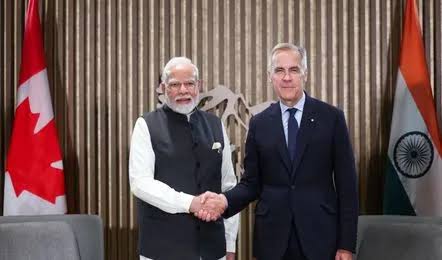
Prime Minister Carney’s visit to India, therefore, is not merely an exercise in diplomatic repair but marks a transformative structural reset with consequences well beyond their bilateral relations
By Swaran Singh
After their trilateral Supply Chain Resilience Initiative of 2021, Prime Minister Mark Carney’s ten-day tour of India, Australia and Japan defines his being the ‘poster boy’ of middle powers driven by his need to wean Canada off its excessive dependence on the United States. And, setting the tone of this travel is his first stop in world’s fastest growing major economy, India — which has also been diversifying away from its dependence on the United States, Russia and China — seems most revealing part of this change in global geopolitical landscape.
Prime Minister Carney’s visit to India, therefore, is not merely an exercise in diplomatic repair but marks a transformative structural reset with consequences well beyond their bilateral relatio and into global trade governance, energy security, and the evolving reassertion of middle powers in an increasingly unstable international system. Equally important to underline is how this is not a reconciliation driven by sentiment or leadership chemistry or lack of it as it was with Prime Minister Justin Trudeau. Mark Carney’s piecemeal recalibration of ties since March last year is driven both by their shared necessity and national interests without any grandstanding or moralizing each other.
From Estrangement to Engagement
What distinguishes the current reset is its methodical character. Canada-India relations had deteriorated sharply since the early 2020s, marked by diplomatic downgrades, suspended dialogues, and mutual recrimination. Compared to that, the past year has seen a piecemeal rebuilding: restoration of high commissioners, reactivation of stalled institutional mechanisms, and insulation of trade, energy, and education cooperation from political polemics.
Both appear to have internalised that relationships function best when anchored in institutions and interests, not in moral posturing, polemics or domestic political signalling. This is what promises Carney’s visit restoring prime-ministerial leadership to a partnership — that had drifted for far too long into strategic underperformance — and to do so without theatrics.
One of the most apt example of the Canada-India roller coaster remains their enduring and yet complicated nuclear cooperation. Canada was among India’s earliest nuclear partners since the 1950s, most notably through a partnership that began with the CIRUS reactor being set at Trombay in India. That of course was to collapse after India’s 1974 nuclear test, freezing cooperation for decades.
What is striking was not the rupture, but the recovery. The 2010 Canada-India Civil Nuclear Cooperation Agreement and subsequent uranium supply contracts in 2015 signalled Canada’s willingness to treat India as a responsible nuclear actor despite its non-NPT status. Few nuclear relationships globally exhibit such an arc — from early collaboration to estrangement and back to selective re-engagement grounded in trust, transparency and safeguards.
This offers a rare template for restoring strategic confidence without erasing differences — a lesson with relevance well beyond Canada-India relations.
Middle Powers in a Fractured World
Prime Minister Carney’s India visit is bound to be read as part of middle-powers’ reassertion under conditions of systemic turbulence produced by great-power rivalries. In a geopolitical environment shaped by the United States economic unilateralism, Russian revisionism, and China’s asymmetric interdependence strategies, middle powers like Canada and India are no longer merely hedging; they are actively re-constructing the architecture of strategic autonomy.
The United States’ increasing reliance on tariffs and transactional alliances, Russia’s normalization of force as an instrument of statecraft, and China’s fusion of market access with political leverage continue to erode the predictability of the liberal international order. For middle powers, this has transformed over dependence into a structural vulnerability rather than a source of security. Carney’s India visit reflects a shared recognition that middle powers must now generate horizontal resilience — through diversification, institutional partnerships, and rule-shaping coalitions — rather than rely on vertical protection from any single hegemon.
Thanks to President Trump tariffs, India has neither been able to finalise its bilateral trade deal nor host the Quad summit. This is where India’s recent FTAs with Australia, New Zealand, UAE, UK, EU as also Canada’s push for trade diversification beyond the United States present their parallel shared responses to this reality. Speaking at the Davos Forum last month Prime Minister Carney had urged middle powers to “resist the temptation to try to curry favour with great powers.” This is where Canada-India reset reflects that broader, quieter coalition-building among middle powers seeking to preserve order without sliding into bloc politics.
From a theoretical perspective, this convergence aligns with post-hegemonic order: stabilising the system without aspiring any kind of dominance. India contributes strategic autonomy, demographic and market scale, and Indo-Pacific centrality; Canada adds resource security, technological depth, and normative credibility in global governance. Together, they exemplify a new mode of middle-power politics — geo-economically anchored, institutionally cautious, and strategically pluralist — aimed at mitigating great-power excesses while preserving systemic stability.
Geo-Economics at the Core
The center of gravity in middle powers search for alternatives unmistakably lies in their building of geo-economic partnerships with likeminded nations. In this Canada and India are seen complementing each other in more than one ways. India is a fast-growing market with immense infrastructure needs, rising energy demand, and ambitions in advanced manufacturing and technology. Canada is a resource-rich, technologically advanced economy seeking to diversify trade away from excessive reliance on the United States.
But much of this remains as yet work-in-progress. Canada-India bilateral trade, currently around USD8-9 billion annually, seems far too below its potential. The expected formal relaunch of their negotiations toward a Comprehensive Economic Partnership Agreement (CEPA) during Carney visit is thus not symbolic but corrective. Both sides have already set ambitious targets: concluding CEPA within a year and scaling bilateral trade toward USD50 billion by 2030.
The strategic and complementary nature of their rapprochement has shown progress in their energy cooperation. As India accelerates its energy transition while retaining nuclear power as a stabilising base, Canadian uranium offers reliability without geopolitical conditionality. The fact that India aims to raise its nuclear power generation by tenfolds to 100 GW by 2047 make its 10-year, $2.8-billion uranium supply agreement with Canada’s Cameco Corp an anchor to their nuclear cooperation. In an era of weaponised supply chains, such predictability carries critical strategic promise.
Indeed, structural recast during Carney’s India visit includes a whole range of collaboration in artificial intelligence and high-technology research, strong education and talent flows, reaffirmation of people-to-people ties — students, professionals, and diaspora networks — that form the social ballast of the relationship and quiet coordination on Indo-Pacific stability and global governance reform. None of these require formal treaty alliances but all require trust and policy coherence — precisely what this visit seeks to consolidate and deliver.
A Partnership Repositioned
Under President Donald Trump, even close U.S. allies have learned that excessive dependence on a single power — even a friendly one — no longer guarantees stability. It is in this backdrop of great-power volatility that Canada and India present a case of repositioning not as dependents or disruptors, but as stabilising stakeholders. Their partnership — rooted in nuclear trust, critical mineral, economic complementarity, and shared concerns about over dependence — offers a model for how middle powers can sustain global order: not by dominance, but by deliberate cooperation among capable, responsible states.
As part of this larger project, Prime Minister Mark Carney’s India visit, deliberately unspectacular, seems to avoid grandstanding and instead restores the relationship at its most productive foundations: economic realism, institutional trust, historical learning, and middle-power commitment for a predictable and inclusive world order. That is why this visit deserves attention not merely as a bilateral event, but as a signal of how middle powers are quietly — but decisively — shaping their re-assertion in the international system.
The author is professor of diplomacy and disarmament at the School of International Studies, Jawaharlal Nehru University, and formerly visiting professor in the Department of Political Science, University of British Columbia.
About The Author
