Kazakhstan and Pakistan Elevate Relations to Strategic Partnership
In total, 19 documents were signed, with 18 additional agreements concluded during Tokayev’s state visit, marking one of the most substantive diplomatic engagements between Kazakhstan and Pakistan in recent years.
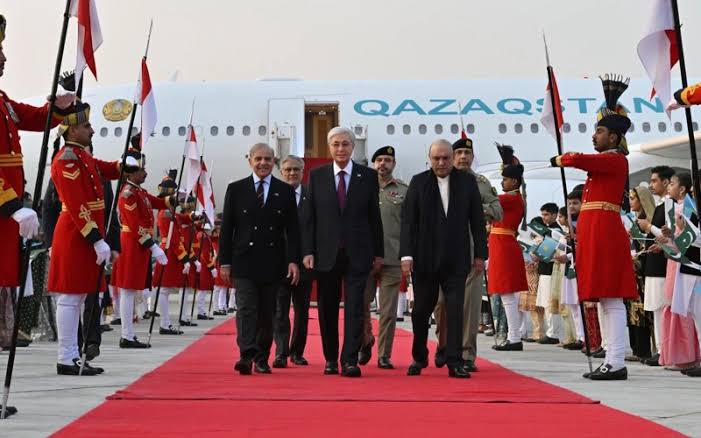
Kazakhstan and Pakistan have signed a Joint Declaration on the Establishment of a Strategic Partnership on February 4, 2026 during the first ever state visit of President Kassym-Jomart Tokayev to Islamabad.
A package of intergovernmental agreements were also concluded, following talks between President Kassym-Jomart Tokayev and Prime Minister Shehbaz Sharif during Tokayev’s state visit on Feb. 4, marking a major step forward in bilateral political, economic and investment cooperation.
“This step elevates our relations to a new qualitative level and opens broad prospects for cooperation across the full bilateral and multilateral agenda,” Tokayev said, speaking at a press briefing.
The Kazakh President was bestowed with the Nishan-e-Pakistan, the country’s highest civilian award.
In total, 19 documents were signed, with 18 additional agreements concluded during Tokayev’s state visit, marking one of the most substantive diplomatic engagements between Kazakhstan and Pakistan in recent years.
Connectivity is Key
Tokayev described the talks as substantive and productive, encompassing an entire gamut of bilateral cooperation. Bilateral trade doubled last year, and both countries agreed to take concrete steps toward increasing trade turnover to $1 billion in the near term.
Tokayev noted that Pakistan’s growing role in transit and logistics could provide Kazakhstan with alternative routes to global markets. The leaders discussed the potential development of transit corridors passing through Afghanistan, including the Kazakhstan–Turkmenistan–Afghanistan–Pakistan railway project.
“We discussed the possibilities of the Pakistani ports of Karachi and Gwadar. The development of the Trans-Caspian transport corridor and transit routes passing through Afghanistan was also considered as a priority issue,” Tokayev said.
The two countries also agreed to explore the resumption of direct air connections to boost business and tourism ties.
New Pathways of Cooperation
In the agro-industrial sector, the sides signed agreements to expand trade and establish joint production facilities. Tokayev also invited Pakistani companies to localize production in Kazakhstan, noting that currently, the most interesting areas in Kazakhstan were agricultural processing, pharmaceuticals, and construction materials.
An agreement to expand mutually beneficial cooperation in the defense industry and highlighted growing interaction between the countries’ security and law enforcement agencies was also announced.
Tokayev emphasized the strategic importance of artificial intelligence and digital technologies for economic growth and confirmed readiness for joint work in these fields. He also pointed to opportunities in Islamic finance, noting that the Astana International Financial Centre offers favorable conditions for the issuance of halal financial instruments.
During the visit, Kazakhstan’s Samruk-Kazyna and Pakistan’s Fauji Foundation established a joint investment platform to develop concrete projects.
Tokayev noted growing interest among Pakistani youth in Kazakh universities, with more than 1,000 Pakistani students currently studying in Kazakhstan. The sides agreed to continue cooperation in science and education.
During the visit, cultural and educational centers named after Al-Farabi, Kanysh Satpayev, and Khoja Ahmed Yasawi were officially opened at universities in Islamabad to strengthen academic ties.
President Tokayev and Pakistan’s Shehbaz Sharif jointly inaugurated the Dostyk Kazakh-Pakistani Sports Center, which will host training in traditional Kazakh sports, as well as chess, boxing, and mixed martial arts.
Sharif described Kazakhstan as one of Pakistan’s most important partners in Central Asia and expressed confidence that the signed agreements would give new momentum to bilateral relations.
About The Author
