President Kassym-Jomart Tokayev ‘s Visit to Japan: A Reflection of Kazakhstan’s Multi-vector Foreign Policy and Economic Development
Kazakh-Japan trade and economic relations is a major pillar of Japan-Central Asia engagement
By Aditi Bhaduri
President Kassym-Jomart Tokayev of Kazakhstan is on his first ever official visit to Japan, 17-20 December. The visit consists of two segments: first engaging in bilateral talks with Japan, the second will be to participate in the Japan-Central Asia summit.
The visit is a reflection of Kazakhstan’s multi-vector and balanced foreign policy, showcasing the country’s engagement with different powers.
Both Kazakhstan and Japan are important partners for each other. While Kazakhstan is a stable partner in Eurasia for Japan, Kazakhstan considers Japan a key partner and a major sourceof investment and technology.
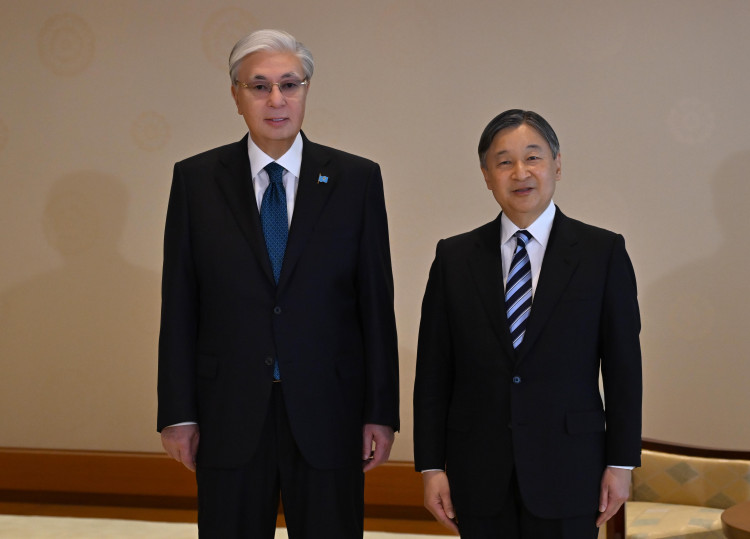
In Japan, President Tokayev met with Emperor Naruhito of Japan on December 18. During the meeting, Tokayev expressed gratitude for the warm hospitality extended by the Japanese side. He noted that Japan has long inspired the people of Kazakhstan with its discipline and resilience, while emphasizing that the two countries are bound by longstanding friendly relations based on mutual respect and cooperation across a wide range of sectors. In turn, Emperor Naruhito expressed confidence that Tokayev’s visit would mark an important milestone in Japan-Kazakhstan relations and help elevate bilateral ties to a new level. The Emperor also hosted an official reception in honor of Tokayev.
President Tokayev also toured Meiji Jingu, Tokyo’s largest Shinto shrine, constructed in 1920 and recognized as an imperial sanctuary.
He also met with Japanese Prime Minister Sanae Takaichi on the same day at the Prime Minister’s Office to discuss prospects for bilateral cooperation.
“Japan has long been a time-tested and reliable partner for Kazakhstan in Asia. It is a harmonious and highly developed country that successfully combines centuries-old wisdom and unique traditions with modern innovation. Under your strong and wise leadership, major reforms are being implemented to further strengthen Japan’s role on the international stage,” Tokayev said.
In turn, Takaichi said that Japan views Kazakhstan as a strategic partner in maintaining and strengthening a free and open international order based on the rule of law.
Economic Underpinnings of Bilateral Relations
Kazakhstan has emerged the most resilient and fastest growing economy in Central Asia. It’s external policies are aimed at promoting trade and investments. Trade with Kazakhstan accounts for more than 70% of Japan’s total trade with Central Asian states. Japan is one of Kazakhstan ‘s largest investors, with total accumulated direct investments amounting to approximately 9 billion US dollars. Japanese companies are actively participating in projects in the mining and metallurgical industries, as well as in the energy and infrastructure sectors. More than 60 Japanese companies currently operate in Kazakhstan, with around 100 enterprises involving Japanese capital. Hence, the partnership is an extremely important one for both parties.
While Kazakhstan is resource rich with an abundance of oil, gas, precious metals, coal, rare earth metals, Japan has cutting edge technology and investment capacity. The two countries are therefore well-placed to synergise their strengths together.
Bilateral trade turnover reached approximately 2 billion US dollars in 2024 and totaled nearly 800 million dollars in the first half of 2025. The main item of Kazakhstan’s exports to Japan is ferroalloys, accounting for about 95% of shipments, while exports of agricultural products, hydrogen, inert gases and copper are gradually increasing. Kazakhstan has also signaled its willingness to export coal to Japan. Imports from Japan include automobiles, industrial machinery and high-tech equipment.
The Kazakh President and Japanese Prime MinisteTakaichi made a joint statement following the talks on Thursday in Japan. Fourteen intergovernmental and interdepartmental agreements were signed.
The visit is expected to bring in commercial agreements worth over $3.7 billion, including energy, renewable energy, digitalization, mining and transport.
Strategically, Kazakhstan pursues multi-vector foreign policy, engaging different powers, like Russia and USA, China and Japan. Kazakh-Japan trade and economic relations is a major pillar of Japan-Central Asia engagement. The very first meeting of foreign ministers in the Central Asia + Japan dialogue format, which was held in 2004, was chaired by Mr. Kassym-Jomart Tokayev. This time around a5 the very first C5+ Japan meeting of heads of state, President Tokayev will be participating in his capacity as head of the Kazakh state.
“The first foreign ministers’ meeting under the framework was held in Astana. Today, such meetings have become so popular that there are many Central Asia+ formats involving major countries, but Japan is rightfully considered the first initiator and founder of this platform,” Tokayev reminisced.
The visit of President Tokayev to Japan is expected to give new momentum to a very important partnership and further expand ties and promote mutually beneficial cooperation between the two countries.
“I am confident that this visit will give new impetus to relations between our countries. Kazakhstan is entering a new stage of development. This year, our economic growth exceeded 6%, which is a strong result. However, we must not stop there. We face tasks related to reducing inflation and modernizing infrastructure. Kazakhstan must become a digital state in the future. We have ambitious goals ahead,” Tokayev said.
From India ‘s perspective this is a healthy and welcome development. India views both Japan and Kazakhstan as important partners in Asia. It has close and cordial relations with both countries and expects their partnership to be beneficial to it. The Japan-Kzzakh partnership ix also an important stabilizing factor in regional and global politics.
About The Author
