Contours of the Greater Game
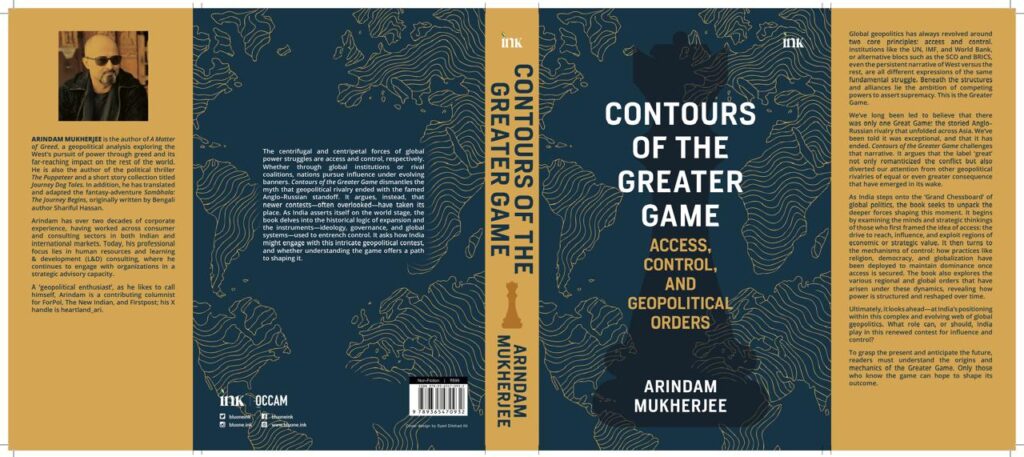
Arindam Mukherjee’s Contours of the Greater Game: Access, Control, and Geopolitical Orders is an ambitious attempt to reframe how we think about geopolitics, power, and history.
Book Review
By Mark Kinra
Arindam Mukherjee’s Contours of the Greater Game: Access, Control, and Geopolitical Orders is an ambitious attempt to reframe how we think about geopolitics, power, and history. While the original “Great Game” is often remembered as a 19th-century rivalry between Britain and Russia in Central Asia, Mukherjee argues that this was only a fragment of a much bigger, ongoing “Greater Game.” This broader game is about who gets access, who exercises control, and how global orders are built and dismantled over time.
The book is structured thematically, with each chapter exploring different dimensions of this vast contest. What makes it stand out is Mukherjee’s ability to blend deep research with an accessible writing style, bringing in anecdotes, big theories, and sharp critiques of conventional narratives. Let’s walk through the chapters one by one.
Chapter 1: Great Minds and the Game of Access
Mukherjee begins by introducing the intellectual giants of classical geopolitics—Halford Mackinder, Friedrich Ratzel, Rudolf Kjellen, Alfred Thayer Mahan, and Nicholas Spykman. These thinkers shaped how nations viewed power in terms of geography, resources, and control.
- Mackinder’s “Heartland Theory” argued that whoever controlled Eastern Europe could dominate the world.
- Mahan highlighted the importance of sea power, shaping naval strategies of major powers.
- Spykman’s “Rimland Theory” suggested that the coastal fringes around Eurasia were just as crucial as the Heartland.
What’s refreshing is that Mukherjee doesn’t treat these as dusty relics. He shows how their ideas live on—whether in NATO’s structure, America’s Cold War containment policies, or current tensions in Eastern Europe.
He also takes a critical approach, asking why certain theories are celebrated while others are sidelined, and how ideas like Lebensraum influenced events from Hitler’s invasion of the USSR to India’s Partition. The chapter mixes intellectual history with sharp analysis, setting the stage for the book’s central theme: access and control are timeless struggles.
Chapter 2: A Great Game – Anglo-Russian Expansion and the Creation of Pakistan
This chapter takes readers deep into the history of the “Great Game” itself. Mukherjee doesn’t just recount the familiar 19th-century rivalry between Britain and Russia; he stretches the story back five centuries, from Ivan the Great to Peter the Great, from Napoleon’s ambitions to the exploits of British spies in Central Asia.
The narrative is vivid and almost novelistic. We meet characters like William Moorcroft, obsessed with Turkmen horses, and Frederick Bailey, who lived undercover in Tashkent in multiple disguises. These stories humanize what could otherwise be a dry strategic account.
The heart of the chapter is the contrast between Russian and British strategies:
- Russia annexed and assimilated Central Asia, putting real “skin in the game.”
- Britain preferred to obstruct cheaply—creating buffer states, using espionage, and manipulating borders.
The chapter culminates in a provocative claim: that Pakistan’s creation in 1947 was less about religious divides and more about geopolitics. Mukherjee argues it was designed as a British-backed buffer, blocking Soviet access to warm waters and fitting neatly into Rimland strategy. This idea is blunt, even controversial, but it pushes readers to see Partition as part of a centuries-long chess match rather than an isolated event.
Chapter 3: Great Stories and the Game of Control
Shifting gears, Mukherjee explores how stories—religious, political, and ideological—have always been tools of control. Drawing on thinkers like Jordan Peterson, Yuval Noah Harari, and Nassim Taleb, he argues that societies run on two hierarchies:
- Competence hierarchies (where ability and achievement rise to the top).
- Dominance hierarchies (where force or coercion keeps order).
Stories bridge the gap between the masses and the elites, mobilizing people to accept or challenge power structures.
He illustrates this through religion:
- Ancient Israel’s monotheism gave Jews a strong identity against larger empires.
- Christianity’s “story of inclusivity” appealed to the poor and destabilized Rome.
- Later, ideologies like democracy and communism replaced religion as mass-mobilizing narratives.
 The chapter is provocative—questioning democracy’s sanctity, comparing corporate management to politics, and criticizing “wokeism” as a modern controlling story. It is less history and more manifesto, but it makes readers rethink the myths that underpin societies.
Chapter 4: Players of the Greater Game
Here Mukherjee zooms out to look at the real “players” of history. He suggests that since Rome’s fall, two forces have shaped global orders:
- The Church (which built order through religion, education, and control).
- The Nomads (diasporic groups who mastered trade, mobility, and finance).
The Church’s strategies—arranged marriages, literacy monopolies, and top-down conversion—are portrayed as early methods of building order. Later, “nomadic” groups such as Jews, Armenians, Parsis, and Chinese merchants extended their influence through global commerce and banking, becoming precursors to modern financial elites.
Mukherjee is unapologetically bold here, likening these financial powers to the Iron Bank in Game of Thrones and drawing parallels to institutions like the Federal Reserve and NATO. For some, this might veer close to conspiratorial, but his larger point stands: the real players of the Greater Game aren’t just states, but transnational elites who shape systems of control.
Chapter 5: The Greater Game
This chapter is perhaps the most wide-ranging, blending philosophy, history, and sociology. Using Zygmunt Bauman’s idea of “liquid modernity,” Mukherjee argues that old “solids” like family, community, and nation-states have been eroded by forces of globalization, industrialization, and postmodern culture.
He links this to:
- Communism’s attempt to erase national identities.
- Global corporations and asset managers (like BlackRock) transcending borders.
- Postmodern ideologies dissolving cultural anchors through “wokeism” and political correctness.
Mukherjee argues that globalization isn’t just economics—it’s part of the ongoing struggle between “solids” (rooted identities) and “liquids” (elites pushing fluid, borderless systems). His examples range from John Lennon’s Imagine to the Great Reset, making this chapter provocative and timely.
Chapter 6: An Asian Game – A Game-Changing Alliance
The final chapter brings the argument home to India. Mukherjee critiques India’s early leadership, especially Nehru, for failing to secure key strategic territories like Chittagong and Pakistan-occupied Kashmir. These oversights, he says, left India vulnerable and forced it into reactive alignments with the USSR and later the West.
More recently, India has shown agility—through initiatives like Vaccine Maitri and a strong G20 presidency—but Mukherjee warns that soft power alone is not enough. He positions India as a “pivot state,” central to world order but often indecisive about its role.
The boldest part of the chapter is his vision of a United Alliance of Asia (UAA): a bloc of India, Russia, China, Iran, and others, capable of balancing Western dominance. It’s speculative, but it forces readers to imagine alternatives to the Western-led global order.
The chapter ends less as detached analysis and more as a call for India to define its destiny: either fully embrace the Western order or help forge an Asian-led balance of power.
Conclusion
Across six chapters, Contours of the Greater Game challenges readers to think differently about geopolitics. It shows that history isn’t just a sequence of wars and treaties—it’s a struggle for access and control, played out by states, elites, religions, and stories.
Mukherjee’s style is wide-ranging, sometimes polemical, often provocative. He blends scholarly references with anecdotes, cultural analogies, and bold judgments. Readers may not agree with all his arguments—especially about Pakistan’s creation or democracy’s flaws—but they will find themselves questioning received wisdom.
For students of international relations, it’s a valuable primer on classical geopolitics. For general readers, it’s a stimulating re-imagination of world history. And for Indian readers, it’s a reminder that the country’s place in the Greater Game is not just reactive but potentially transformative.
About The Author
